

The Himalayan Paradox: Sikkim's Journey from Kingdom to Organic State
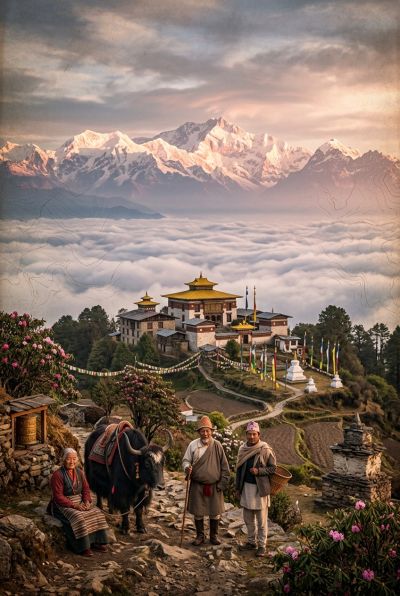
In the shadow of Mount Kanchenjunga lies a story both ancient and urgently modern. William Montclair’s A History of Sikkim offers a sweeping narrative that spans from the animist Lepchas who called their homeland “paradise” to the state’s audacious transformation into the world’s first fully organic region. It’s a tale of survival against overwhelming odds, where myth and monarchy collided with imperial ambitions and democratic aspirations, shaping a unique cultural and political identity that continues to evolve.
What the Book Covers
This is not a dry chronology but a layered exploration organized into 25 chapters plus an afterword, moving chronologically from prehistoric times through the present day. Montclair structures his account around pivotal transitions: the indigenous Lepcha worldview, the Bhutia migration and Buddhist royal institution, British colonial meddling and protectorate status, the explosive path to Indian merger, and the post-1975 reinvention. The intended audience spans history enthusiasts, students of postcolonial geopolitics, and anyone curious about how small states navigate between great powers. The book assumes no prior knowledge but rewards careful reading with nuanced insights into frontier governance, ethnic composition, and the unintended consequences of development.
The Sacred Geography of Origin Myths
Montclair opens by grounding Sikkim’s identity in its literal landscape. The Lepcha creation story, found in Chapter One, is vivid: “their own oral traditions hold that they did not migrate from elsewhere but were created in this very land.” Kanchenjunga becomes a living deity—“It is the eldest brother, created first by Itbu Rum to watch over and protect its younger siblings, the Lepcha people.” These myths aren’t folklore but foundational narratives that would later complicate every political boundary drawn by invaders and imperialists. When the British eventually demanded written treaties, they were forcing secular legalism onto a land whose people measured belonging through sacred geography. The tension between these worldviews recurs throughout the book, from the Bhutia prophecy about the Namgyal dynasty to the Lepcha shamans’ continued spiritual authority alongside Buddhist monasteries.
Colonial Chessboard: Sikkim as Strategic Pawn
Chapters Five through Nine chart how Sikkim became an unwilling player in imperial games. The devastating Nepalese invasions of the 1780s left the capital at Rabdentse “a shattered symbol of a broken kingdom,” Montclair writes. Yet survival depended on playing neighbor against neighbor. The British arrival, detailed in Chapter Six, began with the Treaty of Titalia, where “Sikkim would actively join the war against Nepal. In return…the territories that Nepal had seized…were restored.” But this loyalty was rewarded with increasing control. Chapter Eight’s account of the 1861 treaty shows how British paramountcy crystallized: “British India has assumed the position of paramount of Sikkim and a title to exercise a predominant influence in that State has remained undisputed.” For Montclair, these weren’t just diplomatic maneuvers but the slow erosion of sovereignty, turning a mountain kingdom into “a pawn in imperial geopolitics.” The book’s strength lies in showing how external powers reshaped internal politics with lasting consequences.
The 1973 Revolution and Its Quiet Engineers
The political upheaval of 1973 gets extensive coverage in Chapters Seventeen and Eighteen. Montclair doesn’t romanticize the agitation but reveals its complex mechanics. When the Indian government learned that Chogyal Palden Thondup Namgyal “made contact with the Chinese delegation” during Nepal’s 1975 coronation, it catalyzed decisive action: “India’s strategy, it seems, was to encourage the agitation to a point where the Chogyal’s administration would collapse.” The Tripartite Agreement of May 1973 isn’t portrayed as a spontaneous compromise but as a carefully negotiated framework where “the Chogyal’s dream of a sovereign, independent monarchy was shattered.” Montclair shows how the referendum of April 1975—“the official results…97.5 percent of voters” supporting merger—was the endpoint of a process steered by New Delhi. The author’s tone is measured, acknowledging both the dignity of the old order and the legitimacy of democratic demands while highlighting the asymmetry of power between a small monarchy and a regional superpower.
Hydropower, Floods, and the Price of ‘White Gold’
Chapter Twenty-Four confronts the unintended consequences of Sikkim’s hydropower ambitions. Montclair details the “cascading series of dams and power stations” that aimed to make the state “a powerhouse of India,” but warns of ecological costs. The catastrophic glacial lake outburst flood of October 2023, which “completely destroyed” the Teesta-III dam at Chungthang, becomes a grim validation: “The disaster was a brutal confirmation of the environmentalists’ worst fears.” The narrative here is clear-eyed—Montclair doesn’t dismiss development but illustrates how “the promise of clean energy was a mirage that ignored the permanent destruction of the riverine ecosystem.” These sections are especially relevant as climate change intensifies Himalayan risks, offering a cautionary tale about infrastructure in fragile zones.
The Organic Revolution as Cultural Continuity
The final chapters pivot to a remarkable reinvention. Montclair traces how Sikkim’s 2003 decision to pursue “full organic farming” emerged from “a unique convergence of political will, ecological pragmatism, and cultural disposition.” The “Sikkim Organic Mission” wasn’t merely policy but a “conscious and courageous decision to forge a different path.” By 2016, the state won the UN FAO Future Policy Gold Award, praised as “an outstanding example on how to successfully transform the food system.” Montclair connects this back to Lepcha reverence for land—“the Lepcha’s tranquil existence was forever altered” by external forces, yet their animist principles persisted in the organic ethic. It’s a powerful example of how ancient values can be repurposed for modern challenges, positioning Sikkim not as a relic but as a laboratory for sustainable development.
Overall, Montclair delivers a well-paced, thoroughly researched account that balances scholarly rigor with narrative clarity. His chapters on the 1973 agitation and the post-merger transformation are particularly strong, showing how local agency and external intervention intertwined to reshape destiny.
Who Should Read This
This book will engage readers interested in South Asian frontier histories, the legacy of British colonialism in the Himalayas, and the challenges faced by small states navigating between regional powers. Those studying environmental history or sustainable development will find the organic farming sections particularly compelling. Readers seeking light summaries or romanticized tales of monarchy may find the detailed political analysis dense, but anyone curious about how myth, migration, and modernization forged a unique Himalayan identity should find Montclair’s account both illuminating and deeply rewarding.
This is a substantial work that deserves careful reading, offering insights applicable far beyond Sikkim’s borders.
Read “A History of Sikkim” on MixCache.com →
Please log in or create an account to leave a comment.
No comments yet. Be the first to say something.