

An Excerpt from “The Black Sea Bridge: Trade, Culture, and Conflict on Europe's Eastern Edge”
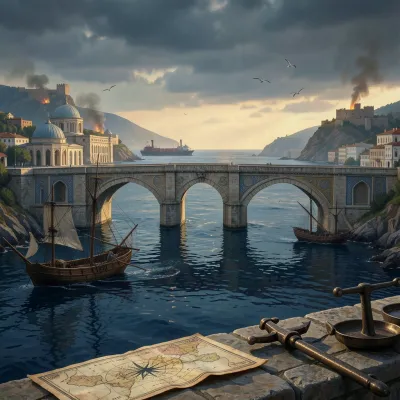
The following is an excerpt from “The Black Sea Bridge: Trade, Culture, and Conflict on Europe's Eastern Edge” by Daniel Wagner, available on MixCache.com.
Introduction
The Black Sea is often imagined as a margin—a dark ellipse tucked behind Europe’s better-known seas. This book proposes a different view: the Black Sea as a bridge, not a boundary. For millennia, its waters have ferried merchants, soldiers, pilgrims, and stories between the Balkans, Anatolia, the Caucasus, the steppe, and the Levant. It is a middle sea where Europe, Asia, and the Middle East have met through commerce and conflict, producing a dense weave of connections that shaped the continent far beyond the shoreline.
Our central claim is straightforward: to understand Europe’s past and its present geopolitical tensions, we must look eastward to the ports and passageways of the Black Sea. From ancient colonies to imperial capitals, from grain booms to oil corridors, this maritime world continuously reconfigured power and exchange. The Black Sea’s eastern frontiers—so often understudied—did not merely echo decisions made elsewhere; they set agendas, redirected trade, and reframed continental politics. Seeing the region as a system of routes rather than as a ring of borders reveals how peripheries act as engines of historical change.
Ports are the protagonists of this narrative. Istanbul, Odesa, Varna, Constanța, Trabzon, Batumi, Sevastopol, and smaller harbors along the Danube delta and Anatolian coast functioned as hinge points between sea and hinterland. Through these nodes flowed grain, timber, furs, and enslaved people in earlier centuries; later came coal, kerosene, textiles, and eventually oil and containerized goods. Dockyards, customs houses, and warehouses stitched mountains and plains to maritime lanes, translating local abundance and scarcity into global prices—and global politics. By following ships’ logs, cargo manifests, and port regulations, we can watch empires assemble and unravel at the water’s edge.
Equally vital are the diasporas that navigated these currents. Greek, Armenian, Jewish, and Tatar communities—among many others—formed trading diasporas that linked rival empires and rival faiths. Their synagogues, churches, caravanserais, and guild halls served as insurance networks long before marine underwriters and as cultural brokers long after flags changed. Diaspora routes were durable but not invulnerable: pogroms, expulsions, and population exchanges remapped families as ruthlessly as treaties redrew borders. Yet across rupture and return, these communities carried techniques, tastes, and texts that remade urban life around the sea.
Empire-building is the book’s third pillar. Successive regimes—from Greek colonists and Rome to Byzantium, Khazaria, the Mongol ulus, Genoa and Venice, the Ottomans, and the Russian and Soviet states—treated the Black Sea as prize, moat, and marketplace. Control over straits, tariffs, and coaling stations could shift the balance of power across continents. Military campaigns and commercial concessions were often two sides of the same policy, and the sea oscillated between being an “imperial lake” and a contested commons. By tracing law and logistics together, we see how sovereignty at sea has always been negotiated as much by insurers and shipfitters as by admirals.
Methodologically, this is a work of connective history. It braids microhistories—an Odessa baker’s ledger, a Trabzon shipping agent’s correspondence, a Varna dockworker’s oral testimony—with structural forces such as climate variability, technological change, and shifting legal regimes. Sources range from travelogues and multilingual newspapers to diplomatic archives, archeological surveys, and environmental data. The aim is not to flatten difference but to show how difference travels: how a new milling technique in the Danubian plain might alter bread prices in Cairo, or how a treaty clause in Paris could redirect a caravan in Tiflis.
The chapters proceed roughly chronologically while returning to thematic threads. Early sections map ancient circuits and medieval entanglements; middle chapters explore Ottoman and Russian ascendance, the rise of merchant republics, and the technological accelerations of steam, rail, and telegraph. The nineteenth century’s “Eastern Question,” together with the Crimean War, anchors a pivot to modern media, medicine, and global finance. Twentieth-century upheavals—revolution, famine, occupation, and the Cold War—recast the coastline yet again, culminating in the post-1991 reordering of ports, privatization, and energy corridors. Final chapters consider culture in motion and the mounting ecological pressures that will shape the sea’s future.
Above all, this book asks readers to reconsider the direction of influence in European history. Instead of beginning in imperial capitals and looking outward, we start on the quays and in the bazaars where sailors negotiated rates, migrants purchased passage, and dockworkers remade cities shift by shift. From these vantage points, the Black Sea is not Europe’s edge but one of its organizing centers. To follow its routes is to see how trade creates cultures, how cultures authorize power, and how power, in turn, redirects trade.
Trade, culture, and conflict have never been separable on Europe’s eastern edge; they are braided like mooring lines along a windy quay. The Black Sea’s story is therefore not a regional subplot but a continental script. By restoring the ports, diasporas, and empires of this sea to the foreground, we gain a clearer view of how Europe became entangled with its neighbors—and how those entanglements continue to shape the present.
Read “The Black Sea Bridge: Trade, Culture, and Conflict on Europe's Eastern Edge” on MixCache.com →
Please log in or create an account to leave a comment.
No comments yet. Be the first to say something.