
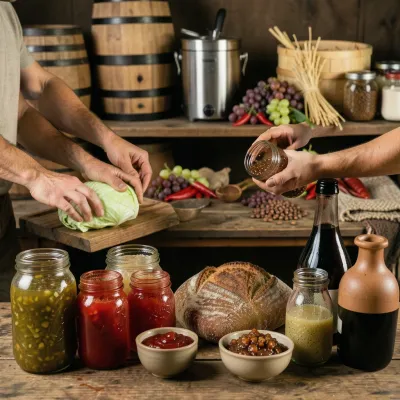
Fermentation Nation: Global Traditions of Food and Wine Making offers something increasingly rare in food literature—a book that respects both the science and the soul of its subject. Mendoza doesn't just catalog fermented foods; she reveals how invisible microorganisms across continents have solved the same preservative and flavor challenges in remarkably similar ways. With detailed chapters on everything from Korean kimchi houses to Norwegian kveik yeasts, the book serves equally well as a cultural atlas and a practical guide.
Understanding the Invisible Players
The book's greatest strength lies in its patient explanation of microbial alchemy, beginning with the fundamental question of what actually happens during fermentation. Chapter Two devotes careful attention to the three primary microbial players—yeasts, bacteria, and molds—explaining how each contributes distinct metabolic toolkits to the fermentation process. The text emphasizes that these microbes behave "more like opportunistic neighbors drawn by the smell of open doors" rather than organisms waiting obediently for instructions. This biological reality reframes fermentation from a precise science to a collaborative art, where the fermenter's role is "to choreograph conditions that favor the ones you want while politely discouraging the rest." The practical implications are profound: understanding that lactic acid bacteria thrive in anaerobic conditions while acetic acid bacteria demand oxygen fundamentally changes how readers approach everything from kraut crocks to vinegar production.
The Universal Language of Salt, Time, and Temperature
Mendoza identifies salt, time, and temperature as fermentation's core variables in Chapter Three, positioning them as universal translators across cultural boundaries. These three factors form "the quiet rulers that decide whether a ferment will reward patience with brilliance or punish haste with disappointment," and each performs multiple roles simultaneously. Salt acts as both seasoning and selective pressure, drawing water from cell walls while shaping microbial societies through osmotic gradients. The chapter's treatment of salt percentages offers practical wisdom: "Too little salt and the environment can tip toward uneven fermentation or unwelcome molds, while too much salt can stall microbial activity altogether." Time is presented in stages—lag, brisk middle phase, and slower tail—requiring adjustment based on microbial cues rather than rigid calendars. Temperature emerges as a master dial that can compress or stretch timelines, with the observation that "these ranges are not strict borders but zones where particular flavors and textures are most likely to emerge." This framework proves invaluable when the fermentation goes sideways, providing troubleshooting guidance rooted in cause-and-effect rather than mysticism.
A World Tour of Cultural Fermentation
The book's cultural atlas spans five continents, revealing how different climates and local ingredients have shaped distinct regional identities through shared microbial processes. Chapter Four explores Korea's fermentory traditions, introducing readers to the concept that "kimchi isn't often generalized as spicy fermented cabbage" but actually encompasses "hundreds of regional variations made from an astonishing array of vegetables." The detailed explanation of jang production shows how Korean fermented pastes rely on "deliberate choreography of mold, salt, and time," with meju blocks left to ferment outdoors where they are "inoculated with ambient microorganisms." Chapter Six reveals China's cellar traditions, where doubanjiang ferments rely on "a complex choreography of mold, yeast, and bacteria" taking turns to shape aroma and texture. The text notes that these ferments are "brisk acid production and layered spice" requiring careful salt management. Southeast Asian traditions in Chapter Eight showcase how "the warmth of the climate allows for brisk fermentation and rapid acid development," creating pungent fish sauces and shrimp pastes that "can soften and ferment quickly, yet cooler storage allows flavors to deepen and meld." Each regional exploration connects back to the core variables while celebrating local adaptations.
Modern Revival and Innovation
The book bridges historical preservation with contemporary craft movements, particularly in its treatment of natural wines and revived ancient techniques. Chapter Fifteen explores vineyard microbiomes where "natural wine carries vineyard yeasts into the bottle," emphasizing that "microbial terroir matters, shaping flavor and function in ways that chemical additives cannot replicate." The discussion of amphorae in fermentation connects to ancient Georgian qvevri winemaking, showing how "porous clay...allows a slow, controlled exchange of oxygen" that creates distinctive results. Chapter Nineteen tackles the modern Garum 2.0 movement, explaining how chefs and artisans are reviving Roman-style ocean ferments using "temperature-controlled environments" rather than relying purely on fermentation luck. The innovation extends beyond technique to philosophy, with the observation that "Garum 2.0 isn't about historical reenactment for its own sake; it's about harnessing ancient wisdom with modern precision to create new flavor dimensions." This section reveals fermentation as living tradition rather than museum piece, continually adapting while retaining essential principles.
Practical Wisdom for Modern Fermenters
The book's final sections provide concrete guidance that moves beyond general philosophy to actionable knowledge. Chapter Twenty on safety emphasizes that sanitation removes "much of the guesswork" rather than demanding sterilization, noting that "recipes provide starting points, but intuition grows from watching how these factors interact in your own space with your own ingredients." The importance of sensory diagnostics is made explicit: "Off smells, unexpected colors, or slimy textures signal trouble, while bright acidity, clean aroma, and firm texture confirm that the microbial community is thriving." Chapter Twenty-Four guides readers through beginner projects while reinforcing core concepts, explaining that sauerkraut requires "approximately one and a half tablespoons of fine sea salt for every pound of cabbage" to create proper selective pressure. The advanced projects in Chapter Twenty-Five reward patience and sensory development, suggesting that "these judgments are not made from textbooks but from the accumulated experience of paying close attention to every batch." Mendoza consistently emphasizes that fermentation is "alive, and living systems respond to nuance rather than commands," requiring adaptive thinking rather than rigid adherence to formulas.
Philosophical Approach to Living Food
Mendoza frames fermentation as partnership rather than conquest, rejecting the industrial model in favor of collaborative relationships with microbial communities. The introduction notes that "fermentation thrives on observation, patience, and iteration; it rewards curiosity with flavors no industrial shortcut can reproduce." This philosophy extends throughout the book's treatment of artisans, whom the text describes as "custodian, coaxing complex flavors from simple ingredients with patience, observation, and a deep respect for the subtle power of the wild." The book argues that "the beauty of fermentation lies in this balance between control and surrender, where precise variables meet living complexity" rather than demanding absolute predictability. This respectful approach extends to safety considerations, which are presented as understanding microbial thresholds rather than imposing sterile perfection: "Traditional knowledge teaches us to respect thresholds—salt percentages, temperatures, pH, and time—as nonnegotiable boundaries that protect both maker and eater." The result is a book that respects fermentation's wild nature while providing frameworks for consistent results.
Who should read this book? Home cooks curious about fermentation's science beyond basic recipes, food enthusiasts interested in cultural connections through culinary traditions, and anyone seeking to understand sustainable food preservation will find deep value here. Readers comfortable with technical detail but seeking practical application—those who want to move beyond kraut basics to understand why their miso develops different flavors or how to troubleshoot finicky sourdough—will appreciate the book's balanced approach. The text assumes some kitchen experience but rewards careful attention with actionable insights. Those seeking quick-fix recipes or simplified explanations may find the technical depth overwhelming, but readers willing to engage with microbial complexity will discover a rich resource for understanding one of humanity's oldest and most universal food technologies.
Fermentation Nation succeeds because it treats its subject as both ancient art and living science, offering enough technical detail to build confidence while honoring the cultural wisdom that developed these practices. Mendoza's approach—explaining microbial behavior while celebrating regional adaptations—creates a book that feels both authoritative and accessible. Whether readers want to understand Korean jang chemistry or revive Roman garum techniques, they'll find principled guidance rooted in both tradition and practical experience. This is essential reading for anyone serious about fermentation's deeper possibilities.
Read “Fermentation Nation: Global Traditions of Food and Wine Making” on MixCache.com →
Please log in or create an account to leave a comment.
No comments yet. Be the first to say something.