

An Excerpt from “Living In Suburbia For Young People”
The following is an excerpt from “Living In Suburbia For Young People” by Kairos Valente, available on MixCache.com.
Introduction
"Sterile," "vacuous," "boring," and "oppressive." These are just a few of the words people often reach for when trying to describe life in the American suburbs. If you’ve picked up this book, chances are you’re familiar with the feeling. It’s the sensation of standing on a perfectly manicured lawn, surrounded by nearly identical houses, under a sky that feels just a little too big and empty. It's the quiet hum of a Saturday afternoon where the most exciting event on the horizon is the mail truck making its rounds. It’s the frustration of knowing that a simple cup of coffee or a meeting with a friend requires a car, a licensed driver, and a significant chunk of time. You might feel like you're living in a bubble, an island of cul-de-sacs and strip malls, disconnected from the vibrant, chaotic energy of a city.
This feeling isn't just in your head. The very design of many suburbs can lead to a sense of isolation and alienation, a unique kind of loneliness that comes from being surrounded by people but disconnected from a shared public life. Child psychologists have pointed out that the structure of suburban life, with its emphasis on private homes and car travel, can leave young people feeling ignored and left out. Many communities simply lack those essential "third places"—the parks, community centers, and casual hangouts that aren't home or school—where you can simply exist, meet people, and feel like part of a community. For teenagers and young adults, especially those without a driver's license, this can feel like a trap. You're told you're living the "American dream" in a safe neighborhood with good schools, but you can't shake the feeling that you're just... bored.
The story of the American suburb is a relatively new one, but it has profoundly shaped the country. The great suburban boom after World War II was fueled by a desire to escape the crowded city for a life of more space, more greenery, and more security. Returning veterans, aided by government-backed loans, moved their families in massive numbers to newly built communities. Housing starts skyrocketed, from just 114,000 in 1944 to nearly 1.7 million by 1950. Places like Levittown, New York, became the blueprint, offering mass-produced, affordable single-family homes that made homeownership accessible to a wider swath of the middle class. This migration was one of the most significant in American history; between 1950 and 1970, the suburban population nearly doubled to 74 million.
This explosive growth was made possible by the automobile. As car ownership became nearly universal, developers could build communities further and further from city centers, connected by an ever-expanding network of highways. The result was "sprawl," a landscape of low-density housing tracts, winding roads, and commercial strips accessible only by car. This design had consequences. Regional architectural styles gave way to a handful of uniform home designs—ranches, split-levels, and Cape Cods—that could be found from coast to coast. The car-centric layout also meant that the vibrant, walkable street life of cities was replaced by the private backyard and the two-car garage.
For the young people who call these places home today, this history has created a unique set of challenges. The very things that appealed to an earlier generation—the quiet, the privacy, the separation from the hustle and bustle—can feel like drawbacks. Public transportation is often limited or nonexistent, making a car an absolute necessity for work, socializing, or any kind of independent life. This car dependency can be a major hurdle, creating a state of forced reliance on parents or older friends for even the simplest errands or get-togethers. It’s a common complaint: without a car, you have no life.
Beyond the logistical issues, there’s a cultural component to suburban boredom. The landscape is often dominated by the familiar logos of chain restaurants and big-box stores, creating a sense of homogeneity. It can feel like you're living in a place that lacks originality, diversity, and the kind of spontaneous encounters that make urban life so appealing. The social circles can feel small and insular, creating a "bubble" effect where it's hard to meet new people or find those who share your specific, niche interests. The physical layout of neighborhoods, with their focus on private yards rather than communal spaces, often discourages the kind of casual, unplanned interactions that build a strong sense of community.
This environment can also take a psychological toll. Studies have suggested that the isolation and achievement pressure in some suburban communities can be linked to higher rates of anxiety and depression among young people. The feeling of being "trapped" isn't just about physical mobility; it can be an emotional state as well. The pressure to conform, the lack of diverse outlets for self-expression, and the sheer monotony can be draining. When every day looks the same, and the landscape offers little in the way of surprise or discovery, it’s easy to feel like you’re just waiting for your "real" life to begin somewhere else.
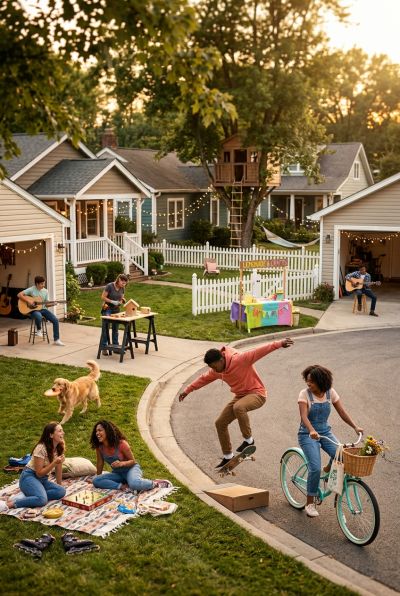
But here’s the central idea of this book: your life doesn't have to be on hold. Suburbia doesn't have to be a life sentence of boredom. It's easy to look at the manicured lawns, the strip malls, and the endless cul-de-sacs and see a finished, unchangeable landscape. But what if you looked at it differently? What if you saw it not as a prison, but as a blank canvas? This guide is built on the belief that with a shift in mindset and a toolkit of new ideas, you can fundamentally transform your experience of suburban living. It’s not about pretending the suburbs are something they’re not; it’s about discovering the hidden potential that lies just beneath the surface of the ordinary.
This isn’t about waiting for someone else to build a cool music venue or open a quirky coffee shop. It's about recognizing that you have the power to create your own culture, your own entertainment, and your own community, right where you are. The quiet streets that seem so boring can become the perfect track for a late-night bike ride or a game of street hockey. That generic patch of woods behind the elementary school might be the ideal spot for building a fort or trying your hand at identifying local plants and animals. The garage that’s just sitting there collecting dust and old lawn furniture could be transformed into a workshop, a photo studio, or a rehearsal space for your band.
Throughout this book, we'll explore the vast, often-overlooked territory of your own suburban world. We’ll start by recalibrating your perspective, treating your town not as a place to escape from, but as a landscape to be explored. We'll dive into the practical ways you can turn your own home and yard into a headquarters for creativity and fun, from hosting an unforgettable backyard bonfire to starting a DIY project that reclaims your personal space. You'll learn how to look at familiar places like the local library and the town park with fresh eyes, discovering resources and opportunities you never knew existed.
We’ll also venture further afield. This guide will provide you with strategies for mastering the art of the day trip, using your suburban home as a launchpad to explore the wider universe of nearby towns, state parks, and quirky roadside attractions. We’ll tackle the often-daunting task of finding your tribe, offering concrete ways to connect with like-minded people through local meetups, volunteer opportunities, and online communities that bridge the digital and physical worlds. From starting a book club to organizing a guerrilla art campaign to beautify the beige, you'll find that you have more agency than you think.
Of course, we won’t ignore the real-world challenges. We'll address the practicalities of navigating a world built for cars, whether that means figuring out the local bus schedule or finding creative ways to get around without your own wheels. We'll look at how you can find or create your own fun (and even make a little money) through the gig economy, turning your skills and passions into fulfilling projects. And we’ll touch on how to engage with your community on a deeper level, from becoming a local historian who uncovers your town’s hidden stories to getting involved in local issues that matter to you.
This book is a guide, a map, and a collection of starting points. It is not a magic wand. Transforming your suburban experience will require effort, curiosity, and a willingness to step outside your comfort zone. It will mean being the person who initiates the plan, who organizes the event, who suggests the adventure. It might feel awkward at first. You might try something that doesn’t work. But every attempt is a step away from passive boredom and a step toward an active, engaged life. The goal is to replace the feeling of "there's nothing to do" with a new question: "What's next?"
You hold in your hands a guide to not being bored. It’s a toolkit for explorers, creators, and community builders who just happen to live in a place with a lot of lawns. The following chapters are filled with ideas, big and small, that you can adapt, combine, and build upon. Your suburban adventure is waiting. It’s time to unlock the front door, look past the picket fence, and begin.
Read “Living In Suburbia For Young People” on MixCache.com →
Please log in or create an account to leave a comment.
No comments yet. Be the first to say something.