
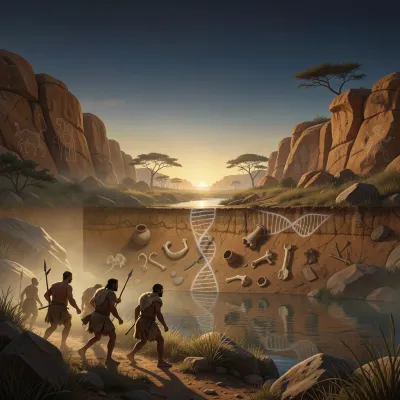
The story of human origins doesn't unfold in a straight line—it pulses with movement, adaptation, and the restless energy of people navigating a changing continent. Echoes of Early Africa: Paleolithic Migrations and the Birth of Civilizations offers a rare synthesis that treats the continent not as a cradle but as a dynamic stage where humanity's deepest history played out across shifting landscapes. This is a book that makes us rethink not just where we came from, but how we got there.
A Multidisciplinary Approach to Deep Time
Burns structures her ambitious work around three core disciplines: archaeology, genetics, and climate science. This framework proves essential for understanding a story that unfolds across multiple timescales. She explains in the introduction that these three lines of evidence 'weave them into a single, accessible story,' emphasizing that Africa's role as the cradle of humanity extends far beyond simple origins to encompass 'continuous innovation and movement.' The book's 25 chapters follow a logical progression from Africa's geological foundations through early tool technologies, the emergence of modern humans, and ultimately to the development of agriculture and metallurgy. This organization makes complex material accessible without oversimplifying, taking readers from 'Africa Before Us' through 'Methods and Myths' in a carefully scaffolded journey.
Climate as the Hidden Director
The book's treatment of climate cycles reveals how planetary-scale changes shaped human destinies. Burns details how the African monsoon expanded and contracted across thousands of years, turning the Sahara from desert to savanna and back again. She describes these wet phases as creating 'temporal corridors that linked North Africa with sub-Saharan regions in ways that were possible only when the desert bloomed.' This 'Sahara Pump' mechanism becomes central to understanding how populations mixed and separated repeatedly, carrying genetic and cultural innovations across vast distances. The text shows that climate wasn't just background—it was 'an active participant in the human story itself, shaping our ancestors' bodies, minds, and societies.'
The Social Lives Behind the Artifacts
Beyond bones and tools, Burns reveals how early humans built complex social worlds. In the chapter on fire and pigment, she notes that hearths 'reorganize space, carving out a domestic sphere where bodies can relax and faces can be seen.' Cooking, she argues, provided 'metabolic dividends' that 'could be invested in growing brains or supporting longer learning periods for children.' Rock art and symbolic objects weren't decorative afterthoughts but active components of social life—'extensions of themselves, objects that encoded knowledge about landscape, material, and community.' These insights make the people behind the archaeological record feel genuinely human rather than primitive stand-ins.
Following the Movement Networks
The author emphasizes that migration was not exceptional but routine. Her discussion of mobility networks shows that movement happened 'in fits and starts, shaped by climate, technology, social alliance, and sheer contingency.' She demonstrates how stone tools, pigments, and even ideas traveled along the same corridors, sometimes outpacing genetic movement entirely. The chapter on rivers and coasts reveals these features as 'active guides that swell, shrink, braid, and sometimes vanish, still to return with different names and moods.' This perspective transforms our understanding of prehistoric Africa from isolated populations to interconnected communities linked by shared knowledge and mutual dependence.
Who Should Read This
This book serves general readers curious about human origins but unwilling to accept oversimplified narratives, as well as students seeking a comprehensive overview of African prehistory. Burns writes with genuine curiosity rather than academic detachment, consistently separating what is known from what remains uncertain. However, readers seeking detailed technical discussions of archaeological methods or those wanting a quick, entertaining overview may find the measured pace frustrating. Anyone interested in understanding Africa's foundational role in human development—and its continuing influence on genetics, language, and culture—will find substantial value in this thoughtful synthesis.
Please log in or create an account to leave a comment.
No comments yet. Be the first to say something.