

How the Age of Exploration Reshaped Our World
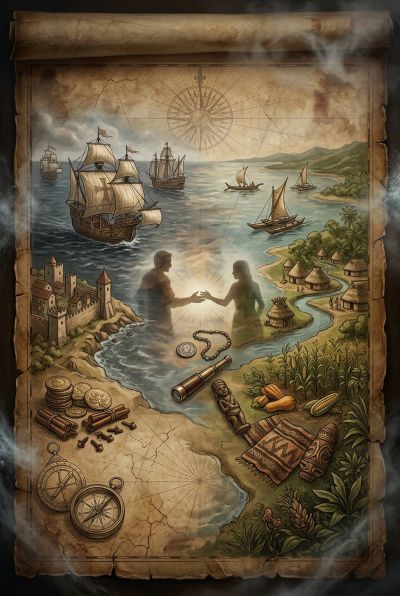
The Age of Exploration was driven by a relentless combination of faith, profit, and prestige—what the author calls the "God, Gold, and Glory" that pushed ships beyond the edges of known maps. But this sweeping narrative is about more than heroic voyages; it reveals the profound contradictions of an era that connected continents while unleashing devastation.
What the Book Covers
George Hargreaves structures The Age of Exploration chronologically across twenty-five chapters, moving from medieval European worldviews to the scientific expeditions of Captain James Cook. The book balances epic discovery with critical reflection, examining not just famous explorers like Columbus and Magellan, but the systems that enabled and profited from their journeys. Readers will encounter detailed discussions of ship design innovations, navigational breakthroughs, the rise of mercantilism, and the brutal realities of colonial exploitation. The intended audience includes history students, curious travelers, and anyone seeking to understand how modern global networks emerged from these early encounters.
The Engine of Empire: Technology and Innovation
The book emphasizes that exploration required revolutionary tools before it could become adventure. Medieval cogs and galleys were unsuited for open-ocean travel until Portuguese shipyards produced the caravel, with its triangular lateen sails that could sail against the wind. "Its triangular lateen sail, long used in the Mediterranean, acted like a wing, allowing a vessel to sail much closer to the wind," the text explains, making probing unknown coastlines possible. Equally crucial were navigational advances: the magnetic compass, astrolabe, and quadrant gave sailors confidence to venture beyond sight of land. These innovations, combined with increasingly sophisticated charts, constituted "the convergence of this entire suite of technologies that enabled the great voyages." Without them, the Age of Exploration would have remained a fantasy.
The Myth of Discovery: Indigenous Resistance and Perspective
Hargreaves repeatedly challenges the Eurocentric framing of these voyages, showing that indigenous peoples were active agents rather than passive subjects. He details specific acts of defiance, such as Hatuey's escape to Cuba and his declaration that Europeans worship gold itself, or the Mixtón War in Mexico where indigenous warriors "successfully repulsed several Spanish attacks and even killed the famous conquistador Pedro de Alvarado." The book dedicates its final thematic chapter to indigenous perspectives, citing documents like the Florentine Codex and the accounts of Popé's Pueblo Revolt of 1680. These voices reveal "not an age of discovery, but an age of invasion," forcing readers to reconsider who was truly discovering whom when ships appeared on unfamiliar shores.
The Columbian Exchange: Life Transformed
Perhaps no chapter is more revelatory than the analysis of what the author calls the "vast and unprecedented biological transfer" between hemispheres. The demographic catastrophe was staggering: "Between 80 and 95 percent of the indigenous population perished in the 150 years following Columbus's arrival." Yet this was only one side of an ecological revolution. The transfer included potatoes, maize, and cassava to the Old World—crops that "provided a caloric safety net that helped to fuel a sustained population increase across much of the continent." Meanwhile, diseases like smallpox became "a far deadlier weapon than any Spanish cannon," while horses revolutionized life on the American plains, transforming buffalo hunting and warfare for tribes like the Comanche and Lakota. The world became biologically unrecognizable within a century.
Mapping Power: Cartography as Political Weapon
The book demonstrates how maps were not neutral tools but instruments of empire, shaping both navigation and territorial claims. Medieval T-O maps depicted the world as a flat disc centered on Jerusalem, while portolan charts offered precise coastal data for familiar Mediterranean waters. When Ptolemy's Geographia arrived in Europe around 1400, it introduced "a systematic approach to mapping the world" using latitude and longitude—though it also contained crucial errors about Earth's size and Asia's extent that made Columbus's western route seem feasible. Equally significant was the 1494 Treaty of Tordesillas, where "two small European kingdoms, with a combined population of less than ten million people, had taken it upon themselves to neatly partition the entire non-Christian world." The act of mapping and naming—Columbus naming San Salvador, Verrazzano claiming Van Diemen's Land—was itself a form of conquest that "embedded deep-seated inequalities" into colonial society.
Who Should Read This
This book will appeal most to readers fascinated by the intersection of technology, economics, and human agency in shaping global history. Those interested in understanding how modern economic systems, international law, and cultural exchange emerged from early modern encounters will find substantial material here. The detailed attention to indigenous perspectives makes it valuable for readers seeking a more complete picture beyond traditional Eurocentric narratives. However, readers looking for light adventure stories or simplified hero tales may find the analytical depth and unflinching treatment of colonial violence too challenging. The comprehensive scope and scholarly approach make it an excellent resource for serious students of history, though casual readers might prefer more focused treatments of specific explorers or events.
Read “The Age of Exploration” on MixCache.com →
Please log in or create an account to leave a comment.
No comments yet. Be the first to say something.