

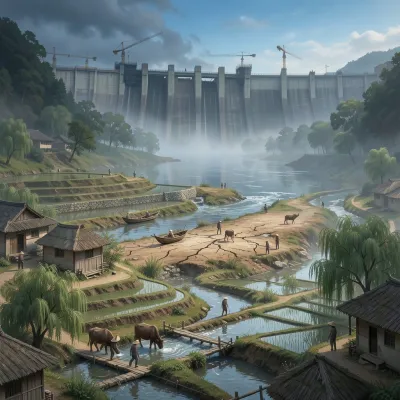
Rivers, Dams, and Famine: An Environmental History of China offers a sweeping narrative that connects the silt-choked waters of ancient dynasties to the concrete sprawl of modern megaprojects. Rather than treating water as a static backdrop, Price demonstrates how rivers have been active agents in shaping China's political legitimacy, social structures, and ecological challenges across millennia. This is not a simple chronicle of engineering feats, but a nuanced exploration of how human ambition and natural forces have continuously negotiated with one another.
What the Book Covers
The book unfolds across twenty-five chapters, beginning with the foundational role of climate and topography and progressing through the evolution of hydraulic statecraft, from the legendary Yu the Great to the Grand Canal. It meticulously traces the interplay between the Yellow River's volatile sediment loads and the Yangtze's paddy-dominated ecosystem, showing how each demanded distinct strategies of control and cultivation. Price does not shy away from the darker chapters of modern projects, providing detailed analysis of the Three Gorges Dam and South-North Water Transfer, while also exploring the social and environmental costs of deforestation, wartime flooding, and famine. The intended audience spans environmental historians, policy makers, and general readers curious about how China's environmental past informs its present and future.
The Mandate of Water and Political Legitimacy
One of the most compelling threads throughout the book is how successful water management became intertwined with a ruler's right to govern. Price traces this concept back to the legend of Yu the Great, who "embarked on a monumental thirteen-year project to dredge river channels and dig irrigation canals," earning him the Xia Dynasty and establishing a precedent where "successful water control became a crucial aspect of imperial legitimacy, a standard by which rulers would be judged for millennia." This "mandate of water" evolved through dynasties, from the Qin-Han canals to Qing inspections, showing that controlling rivers was not just practical but profoundly political. The narrative illustrates how a regime's competence with water infrastructure directly influenced its perceived cosmic right to rule, making droughts and floods not just environmental crises but also political ones.
The Grand Canal as a Cultural and Political Artery
Chapter Seven provides a fascinating examination of the Grand Canal, revealing it as more than just a transport route. Price describes how it "stiched river networks into a single circulatory system meant to move soldiers, tax grain, and stiffen state authority." The canal's history is one of "continuous negotiation between local adaptation and imperial ambition, creating a dynamic that persists in modern debates over dam construction and basin-wide planning." Its role in redistributing ecological risks and benefits across regions demonstrates how infrastructure can both connect and divide communities. The canal's layered history, with each dynasty adding improvements and repairs, serves as a metaphor for the ongoing conversation between human needs and natural processes.
Warfare and the Weaponization of Water
Chapter Eleven explores how military strategy often turned rivers into weapons, with commanders deliberately breaching dikes to stall invaders or redirect resources. Price notes that "war has a way of making rivers seem like levers rather than lifelines, as if their banks were mere hinges that could be pried open to spill misfortune onto enemies." These deliberate floods, while occasionally achieving tactical aims, left long-term scars, "rewriting the terms of engagement between people and the land, with generations inheriting the hydrological debts of earlier wars." The chapter underscores how wartime ecologies, from sudden inundations to redirected flows, reshaped landscapes and communities in ways that persisted long after conflicts ended.
The Three Gorges Dam: Ambition Meets Reality
Chapter Nineteen offers a detailed account of the Three Gorges Project, framing it as both a triumph and a cautionary tale. The dam was "envisioned not only as a structure of concrete and earth but as a statement of intent, an effort to prove that modern China could do what emperors had only fantasized about, which was to pin down a restive river and force it into useful service." While it delivered on promised benefits like energy generation and flood control, Price highlights severe consequences, including "mass displacement, degraded soils, and endangered aquatic ecosystems" and the "hungry water" phenomenon that scours riverbeds. The project exemplifies the tension between grand engineering ambitions and the stubborn realities of sediment loads, ecological disruption, and social upheaval.
Governance and the Struggle for River Rights
The book's final chapter examines how legal frameworks, NGOs, and civil society are redefining water governance. Price discusses how "the concept of "river rights" began to gain currency... arguing for the protection of ecological functions and the communities that depend on them." This emergence of legal and civic engagement reflects a shift where "the idea that rivers could be managed by decree alone had been softened by decades of unintended consequences, displaced populations, and ecosystems that refused to read zoning maps." The author notes how transparency and participation have become crucial, as communities demand more accountable decision-making and recognition of their stake in sustainable river management.
Who Should Read This
This book will satisfy readers interested in environmental history, policy studies, and anyone curious about how infrastructure shapes societies. It offers concrete frameworks for understanding the relationship between natural systems and human governance, making it especially valuable for students and professionals in environmental fields. However, readers expecting a straightforward celebration of technological progress may find its critical examination of costs and trade-offs unexpectedly rigorous. The depth of historical and technical detail makes it most suitable for those willing to engage with complex narratives that resist simple conclusions.
Recommendation: Price's work succeeds in illuminating the profound interdependence of China's ecological and political history. It provides essential context for understanding contemporary environmental challenges and offers a balanced perspective on the costs and benefits of large-scale engineering. Readers seeking to grasp the complexities of sustainable development in China will find it both informative and thought-provoking.
Read “Rivers, Dams, and Famine: An Environmental History of China” on MixCache.com →
Please log in or create an account to leave a comment.
No comments yet. Be the first to say something.