

How Lithuania's Resilient Spirit Shaped a Nation
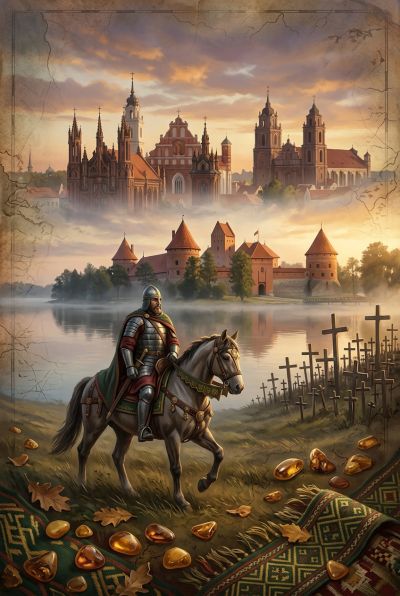
A History of Lithuania by Chester West offers a sweeping exploration of a nation that has repeatedly defied odds to assert its identity. From hunter-gatherers following glaciers to the Singing Revolution, the book reveals how Lithuania's resilience became its defining legacy.
What the Book Covers
This comprehensive volume spans over two millennia, beginning with prehistoric settlements and concluding with Lithuania’s integration into the European Union and NATO. West organizes the narrative into 25 concise chapters, moving chronologically through key phases: the pagan Grand Duchy era, medieval Christianization, the Polish-Lithuanian Commonwealth, Tsarist and Soviet occupations, and 21st-century Western integration. The book targets readers seeking a detailed, balanced understanding of Lithuanian history, particularly those interested in how a small nation navigated between Eastern and Western powers while preserving its language and traditions.
The Grand Duchy's Expansion and Survival
The book illuminates the remarkable expansion of the Grand Duchy of Lithuania under the Gediminid dynasty. Chapter Three details Gediminas's strategic marriages and military campaigns that extended Lithuanian influence "as far south as the approaches to Kiev." Algirdas’s three major campaigns against Moscow, described in Chapter Three, show how the Grand Duchy became "arguably the largest state in Europe," stretching "from the Baltic to the vicinity of the Black Sea." Yet West emphasizes that this expansion required constant warfare, noting that Kęstutis in the west "became the personification of Lithuanian resistance against the crusaders" against the Teutonic Knights. The Gediminid era established Lithuania as a major European power while laying the groundwork for its later struggles to maintain autonomy.
Religious Transformations and Cultural Identity
The turbulent religious landscape of the 16th and 17th centuries forms another core theme. Chapter Nine explores how Calvinism gained traction among Lithuanian nobles partly as a political tool. Mikołaj Radziwiłł's role in "founding the first Calvinist congregation and printing press in Vilnius" exemplifies this trend. However, the Counter-Reformation sparked a fierce Catholic revival, with Jesuits like Piotr Skarga described as wielding influence through "eloquent sermons and writings, often criticizing the perceived disunity and theological errors of Protestantism." The Union of Brest (1596) created lasting divisions, with Orthodox traditions clashing against Uniate conversions. These religious shifts directly influenced Lithuania's cultural and political alliances, shaping its identity during the Commonwealth era.
The National Revival Against Tsarist Repression
Chapter Sixteen uncovers the 19th-century "national reawakening" sparked by figures like Simonas Daukantas, who "portrayed a golden age of Lithuanian freedom and strength" despite the Grand Duchy's medieval origins. The book highlights the Lithuanian Press Ban's unintended consequences: the rise of knygnešiai (book-smugglers) who risked "imprisonment, exile to Siberia, and severe punishment" to smuggle Latin-alphabet texts from East Prussia. The underground Chronicle of the Catholic Church in Lithuania, described in Chapter Twenty-Two, emerges as a vital historical document, meticulously "documenting religious persecution, human rights abuses, and acts of resistance" for nearly two decades. These efforts preserved Lithuanian language and identity during repression, fostering a resistance that would later fuel independence movements.
The Singing Revolution's Peaceful Defiance
West frames the Singing Revolution (1987-1990) as Lithuania's most defining modern moment. Chapter Twenty-Three describes how Sąjūdis (the Reform Movement) evolved from cultural advocacy to political force, transforming "tentative calls for cultural and environmental awareness" into a push for independence. The Baltic Way on August 23, 1989—"where approximately two million people...formed a continuous human chain" from Vilnius to Tallinn—is portrayed as a "powerful, peaceful demonstration" emphasizing unity. The book underscores the emotional resonance of restored symbols, noting how the yellow-green-red flag and national anthem were sung with "fervent emotion" as the Act of Re-Establishment of the State of Lithuania passed the Supreme Council in March 1990. This "Singing Revolution" demonstrated that cultural expression could drive political transformation.
21st-Century Integration and Identity
Chapter Twenty-Five tracks Lithuania's post-Soviet journey into Euro-Atlantic institutions. EU accession in 2004 and NATO membership marked a "definitive return to the political and economic mainstream of Europe," with the Ignalina Nuclear Plant closure representing the cost of integration. The book notes how EU structural funds enabled infrastructure upgrades and helped close the economic gap with Western Europe, while the "Independence" LNG terminal became crucial for energy security. Yet challenges persisted: emigration and demographic decline are framed as ongoing threats, with the text stating that "remittances from emigrants provided a valuable source of income" but the "long-term social and economic consequences of sustained emigration were a subject of national debate." This duality captures modern Lithuania's balance of progress and persistent struggles.
Who Should Read This
This book is essential for readers seeking a deep understanding of Eastern European history, particularly how small nations navigate between empires. Those interested in nationalism, post-colonial resilience, or Lithuania's unique role as a bridge between East and West will find West’s analysis compelling. The detailed exploration of religious dynamics and cultural preservation during occupations offers insights applicable beyond Lithuania. However, readers seeking a light overview or primarily interested in medieval military tactics alone may find the book too broad. It’s best suited for engaged learners who appreciate nuanced narratives connecting past and present, especially those curious about how Lithuania’s "remarkable past and its promising future" continue to shape its national psyche.
Read “A History of Lithuania” on MixCache.com →
Please log in or create an account to leave a comment.
No comments yet. Be the first to say something.