

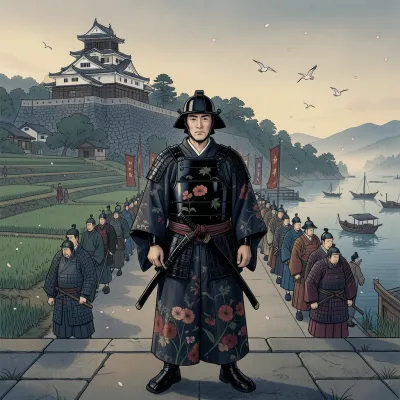
In a world where monarchies ruled through divine right and centralized bureaucracies, early modern Japan achieved something extraordinary: three centuries of dynastic stability without either a crowned sovereign or a uniform state apparatus. Instead, the Tokugawa shogunate constructed a layered order that combined hereditary military rule, semi-autonomous domains, and village-level governance into a resilient framework. Austin Freeman's Tokugawa Order traces how this fragile equilibrium managed to endure through clever institutional design and the relentless management of elite incentives.
The Bakuhan Order as a Hybrid Political System
Freeman's central thesis revolves around the bakuhan order, a hybrid arrangement where the shogunate's court (bakufu) presided over autonomous domains (han) without fully absorbing them. This system was less a blueprint than a set of durable habits, hammered out in the forge of civil war and burnished by cautious peace. The author explains that the shogunate did not abolish local autonomy but bounded it, allowing daimyo to keep their rice fields and retainers provided they accepted limits on castles, marriages, and troop movements. This choreography, as Freeman puts it, 'created a conservative bias that favored stability, not because anyone loved peace with a poet’s passion, but because the cost of breaking the frame exceeded the likely gain.'
Sankin-Kōtai: Ritual as Regulatory Technology
The alternate attendance system (sankin-kōtai) exemplifies how ritualized movement became a regulatory technology. Freeman argues that this practice transformed potentially treasonous energy into paperwork, debt, and display without requiring the shogun to station garrisons everywhere. Daimyo spent every other year in Edo while their families remained as hostages, a strategy that 'turned potentially treasonous energy into paperwork, debt, and display.' The financial burden was immense—maintaining two households and funding elaborate processions drained resources and discouraged rebellion. As Freeman notes, 'This economic capture complemented the more overt mechanisms of hostage-holding and castle regulation, creating a web of obligations that bound daimyo to the center even when they were physically far away.'
The Household State and Familial Control
> The shogunate’s reliance on family ties and hostages created a 'household state' where kinship served as a crucial instrument of political control. Chapter 8 details how the Tokugawa house planted cadet branches like sentinels across the landscape, using adoption and marriage to turn rebellion into a 'domestic nuisance as much as a political threat.' Hostages embedded within the shogun’s capital 'turned family ties into instruments of compliance,' making the regime’s authority feel inevitable rather than imposed. The author emphasizes that this system 'distributed the work of order across many actors, each with a stake in maintaining the fiction of stability.'Village Compacts and the Machinery of Stability
> At the village level, the goningumi (five-family groups) and temple registration systems turned neighbors into mutual wardens, making social order a shared, supervised project. Freeman writes that these devices 'lowered the costs of monitoring, raised the costs of defection, and made punishment predictable—features essential to any long peace.' Village headmen, acting as hinges between peasant households and samurai authority, translated tax quotas into labor and discipline into cooperation. This collective responsibility, while creating opportunities for abuse, also fostered a 'social ecology in which everyone had a stake in maintaining the fiction of stability.'The Unraveling of Stability: Western Demands and Domestic Strains
> Facing converging pressures from Western demands for openness, severe famines, and fiscal contradictions, the Tokugawa order finally frayed. Freeman’s final chapters show how the 'carefully adjusted dial of foreign contact' was forcibly turned by imperialist pressure, undermining the regime’s core strategy of managed engagement. The long peace had nurtured a commercial economy and literate population that now chafed at constraints, while domains like Satsuma and Chōshū leveraged Western military knowledge to challenge shogunal primacy. As Freeman observes, 'The very adaptability that had made the Tokugawa order durable now looked like sclerosis, as institutions optimized for routine struggled to absorb change at the speed history now demanded.'Who Should Read This
> This book will appeal to readers interested in comparative political systems, institutional analysis, and the mechanics of premodern statecraft. Freeman’s meticulous attention to how the shogunate managed constraints through legal codes, marriage alliances, and economic incentives offers insights applicable beyond Japan. However, those seeking a narrative-driven account of samurai culture or a focus on individual historical figures may find the detailed administrative focus overwhelming. Tokugawa Order succeeds as a model of institutional history, demonstrating how a military regime sustained dynastic stability through layered authority and the quiet discipline of everyday governance.Please log in or create an account to leave a comment.
No comments yet. Be the first to say something.