

An Excerpt from “General Motors”
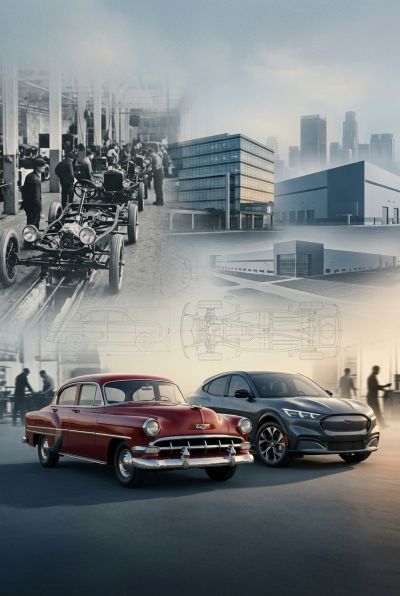
The following is an excerpt from “General Motors” by Carl Johnson, available on MixCache.com.
Introduction
To tell the story of General Motors is to tell a story of America. It is a narrative woven into the very fabric of the 20th and 21st centuries, a sprawling epic of ambition, innovation, hubris, and reinvention. For much of its existence, the axiom "As GM goes, so goes the nation" was not mere hyperbole; it was a reflection of the company's immense scale and its profound influence on the American economy, culture, and landscape. At its zenith, General Motors was not just the world's largest automaker; it was the largest industrial corporation on Earth, a global behemoth whose operations spanned continents and whose products touched the lives of millions. It was a company that put America on wheels, shaped the modern suburb, helped win a world war, and defined the very concept of the corporate ladder.
The tale begins not with a methodical engineer, but with a consummate salesman and audacious visionary: William C. "Billy" Durant. A high-school dropout who made his fortune manufacturing horse-drawn carriages, Durant was initially skeptical of the noisy, unreliable "horseless carriage." Yet, he possessed an uncanny ability to see the future, and in the fledgling automobile industry, he saw an opportunity of unprecedented scale. In 1908, using his already successful Buick Motor Company as a foundation, Durant incorporated General Motors. What followed was a whirlwind of acquisitions, as Durant, driven by a belief in consolidation, rapidly bought up more than 20 distinct companies, including Oldsmobile, Cadillac, and the precursor to Pontiac, creating a chaotic but formidable automotive empire.
Durant's genius was in his grand vision, but his frenetic, seat-of-the-pants management style twice led to his ouster from the company he created. His replacement, Alfred P. Sloan, Jr., was his temperamental opposite. Where Durant was impulsive, Sloan was methodical. Where Durant thrived on chaos, Sloan craved order. An engineer by training, Sloan was an administrative mastermind who took Durant's sprawling, disconnected collection of companies and forged them into the model of the modern American corporation. He instituted principles of decentralized operations and centralized financial control, creating a structure that would be emulated by industries far beyond automaking.
It was Sloan who conceived of the strategy that would propel GM past its archrival, Ford, and establish its market dominance for the better part of a century. Rejecting Henry Ford's one-size-fits-all approach with the Model T, Sloan articulated a new vision: "a car for every purse and purpose." Under this doctrine, GM's brands were meticulously arranged in a "ladder of success." A customer might start with an affordable Chevrolet, and as their prosperity grew, they could move up to a Pontiac, an Oldsmobile, a Buick, and finally, the pinnacle of American luxury, a Cadillac. This, combined with the novel concepts of annual model changes—what would later be termed planned obsolescence—and the creation of the General Motors Acceptance Corporation (GMAC) to provide consumer financing, transformed the automotive market and cemented GM's position at the top.
The sheer might of General Motors became an integral part of the American century. During World War II, the company transformed its vast manufacturing capabilities into the "Arsenal of Democracy," ceasing all civilian vehicle production to churn out an astonishing volume of aircraft, tanks, and armaments for the Allied forces. The post-war years ushered in a golden age, as a prosperous America embraced the open road. GM was there to provide the dream machines, guided by the flamboyant design chief Harley Earl, whose "Art and Color Section" translated the optimism of the era into chrome-laden, tail-finned fantasies like the Chevrolet Bel Air and the Cadillac Eldorado.
Yet, this unparalleled success bred a culture of insularity and bureaucracy that would eventually prove to be a profound weakness. The company's immense size made it slow to react to shifting tides. The rise of organized labor, culminating in the power of the United Auto Workers (UAW), created a new dynamic between management and the assembly line. In the 1960s, a young consumer advocate named Ralph Nader took aim at the Chevrolet Corvair, and his book, Unsafe at Any Speed, thrust automotive safety into the national spotlight, ushering in an era of government regulation that the industry had long resisted.
The challenges continued to mount. The oil crises of the 1970s exposed GM's vulnerability and its overreliance on large, fuel-thirsty vehicles. Simultaneously, a new wave of competition from Japanese automakers offering smaller, more fuel-efficient, and increasingly reliable cars began to steadily erode GM's market share. The company's attempts to respond, such as the ambitious but ultimately troubled Saturn Project, were often a case of too little, too late. A period of diversification saw the company venture into disparate fields, acquiring companies like Electronic Data Systems and Hughes Aircraft, moves that some critics argued distracted from the core business of building better cars.
The dawn of the 21st century saw the global giant stumble badly. Crushing legacy costs, a sprawling and often overlapping brand portfolio, and an inability to adapt quickly enough to a changing global market led to a period of profound crisis. The SUV boom of the 1990s had brought significant profits, but it also masked deeper structural problems. The unthinkable happened in 2009 when, battered by the global financial crisis, General Motors Corporation filed for bankruptcy, the largest industrial bankruptcy in U.S. history.
What emerged from the ashes, after a controversial government bailout and a lightning-fast 40-day restructuring, was the "New GM." Leaner and more focused, the company shed iconic brands like Pontiac, Oldsmobile, and Saturn to concentrate on its core four: Chevrolet, Buick, GMC, and Cadillac. The path forward, however, was not without its own severe trials. A new era of leadership began with the appointment of Mary Barra, the first female CEO of a major global automaker, whose tenure was immediately tested by the massive and tragic ignition switch scandal.
Today, General Motors stands at another historic crossroads, navigating the most profound technological shift in the industry's history since its inception. Having pioneered and then abandoned one of the first modern electric cars, the EV1, the company is now betting its future on an all-electric world. With massive investments in its Ultium battery platform and a pledge to phase out gasoline-powered vehicles, GM is in a high-stakes race to define the future of mobility. At the same time, its Cruise division is at the forefront of the quest for autonomous driving, a technology that promises to once again reshape our cities and our lives.
This book is a portrait of that century-long journey. It is the story of the people, the products, and the pivotal moments that made General Motors an emblem of American industry. It chronicles the company's meteoric rise, its stunning fall, and its ongoing struggle for redemption and relevance in a rapidly changing world. It is a story of immense triumphs and staggering failures, of groundbreaking innovation and stubborn resistance to change. It is, in short, the story of a company that is as complex, contradictory, and compelling as the nation it helped to build.
Read “General Motors” on MixCache.com →
Please log in or create an account to leave a comment.
No comments yet. Be the first to say something.