
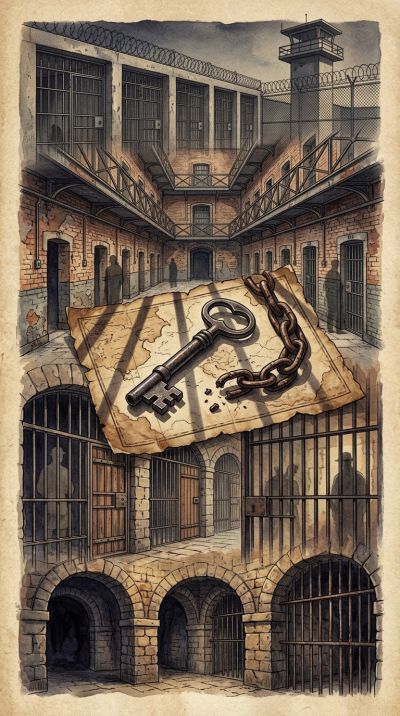
The story of prisons is not a tale of steady progress but of repeating cycles—crises, reforms, and unintended consequences that reshape how societies punish and control. A History of Prisons and Imprisonment walks readers through that turbulent past, from ancient holding cells to today’s supermax complexes, revealing how each era’s ideals about justice, labor, and liberty left lasting marks on stone and steel.
What the book offers is a chronological yet thematic exploration divided into twenty‑five chapters, each building on the last to show how penal thought moved from public spectacles of pain to the modern obsession with isolation and surveillance. Written for anyone curious about the social forces behind incarceration—students, policymakers, or general readers—the volume assumes no prior expertise but rewards careful attention with concrete takeaways about why prisons look the way they do today.
The Enlightenment birth of the penitentiary
The book pins the origin of modern imprisonment to the intellectual shift of the eighteenth century, when reformers began to question the efficacy of public torture and execution. Chapter 3 explains how Cesare Beccaria’s On Crimes and Punishments argued that "the sole purpose of punishment is deterrence" and proposed that loss of liberty, not bodily harm, could serve as a rational, continuous penalty. This idea turned confinement from a temporary holding measure into the punishment itself, setting the stage for purpose‑built institutions designed to reform the soul.
Pennsylvania versus Auburn: two visions of discipline
Chapters 6 and 7 detail the early American experiment with competing penitentiary models. The Pennsylvania System, embodied by Eastern State Penitentiary, insisted on "complete and total separation" so that inmates would confront their conscience in solitude, believing "the silence would become a vessel for the voice of God." By contrast, the Auburn System, developed at New York’s Auburn Prison, kept prisoners in solitary cells at night but put them to work together in strict silence during the day, enforcing order through the lockstep march and the ever‑present threat of the cat‑o’‑nine‑tails. The Auburn model ultimately prevailed because its congregate labor proved far more profitable, turning prisons into self‑sustaining factories.
Race, the War on Drugs, and mass incarceration
Chapter 21 lays bare how the prison population became a mirror of racial inequality. It traces the legacy of the convict lease system, which "effectively re‑enslaved African Americans" after the Civil War, and shows how the War on Drugs amplified those disparities. The text notes the infamous 100‑to‑1 sentencing ratio between crack and powder cocaine, observing that "a Black kid on a street corner with a pocketful of crack rocks received the same mandatory sentence as a major trafficker of powder cocaine," a policy that flooded prisons with low‑level offenders of color and cemented a lasting caste‑like effect.
Solitary confinement and the rise of the supermax
Chapter 23 chronicles the modern turn toward extreme isolation, beginning with the 1983 Marion lockdown that "became the blueprint for a new and profoundly isolating form of imprisonment." It describes the typical supermax cell as measuring "around eighty square feet—roughly the size of a parking space" where prisoners spend twenty‑three hours a day in sensory deprivation. The chapter cites psychological research identifying "SHU Syndrome," noting symptoms such as "perpetual hypervigilance, depression, hallucinations, and uncontrollable rage" and concludes that long‑term solitary is increasingly viewed as a form of psychological torture under international human rights standards.
Alternatives, decarceration, and the Scandinavian contrast
Looking forward, Chapter 25 surveys emerging reforms such as problem‑solving courts, electronic monitoring, and restorative justice, while also noting bipartisan momentum for decarceration driven by both social justice advocates and fiscal conservatives. Chapter 24 offers a striking counterpoint with the Scandinavian model, where prisons like Norway’s Halden aim to "make life inside a prison resemble life outside as much as is feasible," emphasizing normality, dynamic security, and maintaining family ties. The book points out that Norway reports a two‑year recidivism rate of around 20 percent, sharply divergent from the United States’ rates that often exceed 60 percent, suggesting that alternative philosophies can produce different outcomes.
Read “A History of Prisons and Imprisonment” on MixCache.com →
Please log in or create an account to leave a comment.
No comments yet. Be the first to say something.