

An Excerpt from “Bread”
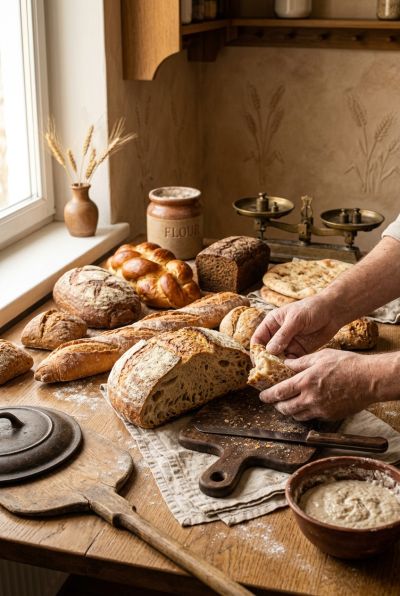
The following is an excerpt from “Bread” by Johnathan Wells, available on MixCache.com.
Introduction
Bread. The word itself is simple, foundational, almost elemental. It evokes warmth, comfort, sustenance. Close your eyes and you can likely conjure the aroma of a freshly baked loaf, the satisfying resistance of its crust giving way to a soft, yielding crumb. It’s a foodstuff so deeply ingrained in human experience that it often transcends mere nourishment, becoming a powerful symbol of life, community, and civilization itself. From the humblest table to the most elaborate feast, bread, in one form or another, is almost invariably present, a constant companion on humanity’s long journey.
It is arguably the most widely consumed food in the world, a dietary cornerstone for billions. Consider the sheer diversity: the crusty French baguette, the chewy sourdough of San Francisco, the dense pumpernickel of Germany, the pliable naan of India, the paper-thin injera of Ethiopia, the corn tortillas of Mexico, the steamed Mantou of China. Each culture has taken the basic elements – typically grain, water, and often a leavening agent – and shaped them according to local tastes, available ingredients, and technological development. This remarkable adaptability is a testament to bread’s fundamental appeal and its ability to integrate seamlessly into different culinary landscapes.
Yet, for all its ubiquity and apparent simplicity, bread holds fascinating complexities. The transformation of humble flour and water into a risen, flavourful loaf is a process bordering on alchemy, a delicate interplay of biology, chemistry, and physics. It requires an understanding of ingredients, a mastery of technique, and often, a good measure of patience. The journey from grain to loaf mirrors, in many ways, the journey of human ingenuity – from basic survival to sophisticated craft. It is a food that can be made with the most rudimentary tools or the most advanced industrial machinery.
Beyond its physical form, bread carries immense cultural and symbolic weight. "Breaking bread" signifies sharing, fellowship, and peace. In many religious traditions, bread holds sacred significance, representing divine provision or sacrifice. It has been used as currency, offered as a symbol of hospitality, and served as a marker of social status – the refined white loaf for the wealthy, the coarse dark bread for the poor. The phrase "our daily bread" encapsulates its role as essential sustenance, a fundamental human need. Throughout history, the availability and price of bread have even sparked riots and revolutions, highlighting its critical role in social stability.
This book, Bread: Its History And Recipes, invites you on a comprehensive exploration of this extraordinary food. We embark on a journey that spans millennia and traverses continents, delving into both the rich tapestry of bread’s past and the practical art of bringing it to life in your own kitchen. It is a story of agriculture, technology, trade, religion, society, and ultimately, the enduring human need to nourish ourselves and connect with one another. We aim to provide not just a historical account or a collection of recipes, but a holistic understanding and appreciation of bread in all its facets.
Our journey begins, as it must, at the dawn of agriculture. We will trace the earliest evidence of humans gathering wild grains, grinding them, and mixing them with water to create primitive gruels and flatbreads cooked on hot stones. This exploration forms the foundation, setting the stage for the revolutionary developments to come. We will consider how the simple act of cultivating grain fundamentally altered human society, leading to settled communities and the first steps towards what we now recognise as bread-making. This era, long before the pyramids or written records, holds the ancient roots of our subject.
From these prehistoric beginnings, we travel to the fertile banks of the Nile, where Ancient Egypt emerges as a cradle of bread innovation. It was here, likely by happy accident, that the miracle of leavening was discovered, transforming dense, flat cakes into light, airy loaves. We will examine the evidence for their sophisticated baking techniques, the different types of bread they produced, and the central role bread played in their diet, economy, and religious practices. The Egyptian mastery of yeast fermentation laid the groundwork for centuries of baking tradition that followed.
Our historical survey then moves to the classical worlds of Greece and Rome. We'll see how bread became increasingly central to the diet of burgeoning urban populations. The Greeks refined baking techniques and developed a wide variety of breads, while the Romans engineered large-scale milling and baking operations to feed their vast empire. We will explore the social stratification reflected in bread types, from the coarse bread distributed to the populace to the finer loaves enjoyed by the elite, and how bread became intertwined with politics and public life – "bread and circuses."
The narrative continues into the Middle Ages, a period often characterised by hardship but also by significant developments in agriculture and craft. We investigate the role of feudalism in grain production, the importance of the local mill, and the rise of bakers' guilds, which regulated quality and training. We'll examine the types of grains commonly used, the challenges of famine and scarcity, and how bread remained a vital, often precarious, staple for peasant and lord alike. The medieval period solidified bread's place at the heart of the European diet.
With the arrival of the Renaissance, we witness a period of refinement and burgeoning regional identities reflected in bread-making. Increased trade introduced new ingredients and influences, while evolving tastes led to greater experimentation. We will look at how baking techniques improved, how regional specialties began to gain prominence across Europe, and how bread featured in the changing culinary landscape of the era. This period saw the beginnings of many bread traditions still cherished today, reflecting a growing appreciation for quality and variety.
The Age of Exploration dramatically expanded the world map, and bread travelled along with explorers, colonists, and traders. We will follow the global spread of wheat and other grains, and the introduction of European bread-making traditions to the Americas, Asia, and Africa. Conversely, we'll also touch upon how explorers encountered diverse existing grain-based foods in newly reached lands, contributing to a broader understanding of what "bread" could encompass. This era marks the beginning of bread's truly global story.
A pivotal transformation occurred during the Industrial Revolution. Mechanisation revolutionised milling and baking, enabling mass production on an unprecedented scale. We will explore the impact of inventions like the steam-powered mill and the automated dough mixer. While increasing efficiency and lowering costs, this era also brought concerns about quality, adulteration, and the changing nature of bakers' work. The iconic, standardised "modern loaf" began to take shape during this period of profound technological and social change.
Bread's critical importance is perhaps never more evident than in times of conflict and hardship. We will dedicate attention to the role of bread during major wars, famines, and economic depressions. From rationing and substitute ingredients ("ersatz" bread) during World Wars to the challenges of maintaining supply lines, bread often became a symbol of resilience, scarcity, and national effort. Understanding bread in these extreme circumstances underscores its fundamental necessity.
The 20th century brought further dramatic changes, including the invention of commercial slicing and wrapping machines, which solidified the dominance of the soft, white, industrial loaf in many parts of the world. However, this century also witnessed a counter-movement: a growing appreciation for traditional methods and artisanal quality. We will chart the rise of the artisan bread revival, the renewed interest in sourdough, whole grains, and regional specialties, setting the stage for today's diverse bread culture.
Finally, our historical overview concludes by looking at contemporary bread culture. We examine current trends, from the gluten-free movement and the focus on ancient grains to the continued popularity of home baking and the vibrant community of professional artisan bakers. We consider how globalisation, health consciousness, and a desire for authenticity are shaping the breads we eat today, celebrating the enduring innovation and tradition within the world of bread.
Having traced the long and fascinating history of bread, the second half of this book transitions from the past to the present, from observation to participation. We move into the kitchen, equipping you with the knowledge and skills to bake delicious bread yourself. This section is designed to demystify the baking process, whether you are a complete novice or have some experience under your apron. We believe that understanding the 'why' behind baking techniques makes the 'how' much more intuitive and rewarding.
We begin this practical journey by exploring the very soul of bread: flour. Chapter 11 delves into the different types of grains used for bread, the milling process, and how variations in protein content, ash, and extraction rates affect the final loaf. Understanding flour is the first crucial step towards becoming a confident baker, allowing you to make informed choices about the foundation of your bread. We’ll discuss common types like all-purpose, bread, whole wheat, rye, and explore some less common but equally interesting options.
Next, we unlock the magic of leavening. Chapter 12 examines the different ways bakers persuade their dough to rise. We explore the world of commercial yeast, explaining the differences between fresh, active dry, and instant varieties. We then dive into the tangy universe of sourdough, explaining how to create and maintain a starter – a living culture of wild yeast and bacteria. Finally, we cover chemical leaveners, typically used in quick breads, understanding how baking soda and baking powder work their rapid magic.
Bread isn't just flour and leavening, of course. Chapter 13 focuses on the essential supporting ingredients: water, salt, and others. We discuss the role of water hydration levels in dough consistency, the crucial functions of salt beyond flavour (controlling fermentation, strengthening gluten), and the effects of adding fats, sugars, dairy, or eggs, which create enriched doughs with different textures and tastes. Understanding these components helps fine-tune your recipes and troubleshoot potential issues.
With the ingredients understood, we move into the science of the dough itself in Chapter 14. This chapter explains the fascinating process of gluten development – how proteins in flour combine with water and kneading to create the elastic network that traps gases and gives bread its structure. We also delve deeper into fermentation, explaining what happens chemically and biologically as yeast or sourdough cultures consume sugars and produce carbon dioxide and flavour compounds. This knowledge empowers you to control the process rather than just follow steps blindly.
No craft is complete without its tools. Chapter 15 introduces the baker's essential toolkit, from basic equipment like bowls, scales, and scrapers to more specialised items like stand mixers, proving baskets (bannetons), and baking stones or steels. We also cover fundamental techniques that apply across many recipes, such as accurate measuring (especially the importance of weighing ingredients), mixing methods, and understanding baker's percentages – a crucial concept for recipe scaling and development.
Armed with foundational knowledge and the right tools, we begin baking in earnest. Chapter 16 focuses on mastering the basic white loaf. This serves as an ideal starting point, allowing you to practice fundamental techniques like kneading, shaping, proofing, and baking, using a relatively forgiving dough. We provide clear, step-by-step instructions designed to build confidence and produce a satisfying, classic loaf – the bedrock upon which more complex baking can be built.
Moving beyond basic white bread, Chapter 17 explores the world of wholesome goodness with whole wheat and multigrain breads. We discuss the challenges and rewards of working with whole grain flours, which contain the bran and germ, offering more flavour and nutrition but requiring adjustments in technique. Recipes will guide you through creating hearty, flavourful loaves packed with the goodness of whole grains, seeds, and nuts.
For many bakers, sourdough represents a pinnacle of the craft. Chapter 18 is dedicated entirely to the tangy world of sourdough. Building on the introduction to starters in Chapter 12, we provide detailed guidance on maintaining a healthy starter, troubleshooting common issues, and adapting sourdough techniques for various types of loaves. Recipes will range from classic rustic sourdough boules to variations incorporating different flours, showcasing the unique depth of flavour achievable with natural leavening.
The tactile experience of working with dough is one of baking's great pleasures. Chapter 19 focuses specifically on the crucial hands-on techniques of kneading, shaping, and proofing. We explore different kneading methods (hand kneading, slap-and-fold, stretch-and-fold), various shaping techniques for different loaf types (boules, bâtards, baguettes), and the critical skill of judging proofing – knowing when the dough is perfectly risen and ready for the oven, a skill that develops with practice and observation.
The final transformation happens in the heat of the oven. Chapter 20 covers the science and art of baking perfection. We discuss oven types, the importance of preheating, the benefits of using baking stones or Dutch ovens, and the crucial role of steam in achieving a good oven spring and a beautiful crust. Understanding how heat transfer works and how to manage the oven environment is key to consistently achieving well-baked loaves with desirable crusts and crumbs.
With the fundamentals mastered, we broaden our horizons to explore iconic breads from around the globe. Chapter 21 celebrates European classics, providing recipes and techniques for beloved breads like the crusty French baguette, the open-crumbed Italian ciabatta, and hearty rye breads characteristic of Northern and Eastern Europe. Each requires specific techniques and offers a distinct taste and texture profile, reflecting its cultural origins.
Sometimes, bread transcends the purely utilitarian and becomes a celebration. Chapter 22 delves into the rich and sweet side of baking, exploring enriched doughs. These doughs, fortified with eggs, butter, sugar, or oil, produce tender, flavourful breads like classic brioche, braided challah, and various festive sweet breads found in different traditions. We explore the techniques needed to handle these softer, richer doughs.
Not all breads are lofty loaves. Chapter 23 takes us on a tour of flatbreads from around the world. This diverse category includes pocketed pita bread, chewy Indian naan, versatile Mexican tortillas, and dimpled Italian focaccia. These breads often have simpler, quicker preparations and offer a different but equally satisfying eating experience, perfect for scooping, wrapping, or dipping. We cover various cooking methods, from griddles to hot ovens.
For those times when patience or yeast is in short supply, Chapter 24 introduces the world of quick breads and soda breads. These rely on chemical leaveners like baking powder or baking soda reacting with an acid (like buttermilk) for their rise. We provide recipes for classics like Irish soda bread, scones, and savoury muffins, showcasing how easy and quick it can be to produce delicious baked goods without waiting for yeast fermentation.
Finally, recognising that dietary needs and preferences are diverse, Chapter 25 ventures beyond traditional wheat bread. We explore the challenges and techniques of gluten-free baking, offering guidance and recipes for those avoiding gluten. We also look at breads made with specialty or ancient grains like spelt, Kamut, or einkorn, which offer unique flavours and nutritional profiles, catering to the growing interest in diversifying our grain consumption.
This book, therefore, is designed as both a historical narrative and a practical guide. It tells the story of how bread shaped human civilisation and how civilisation, in turn, shaped bread. It aims to unravel the science behind the baking process, making it accessible and understandable. And, most importantly, it provides a wide range of recipes, from the simplest loaves to more challenging creations, encouraging you to roll up your sleeves and experience the profound satisfaction of baking your own bread.
Whether you are fascinated by history, eager to learn a new skill, or simply someone who appreciates the simple pleasure of a good slice of bread, we hope this journey enriches your understanding and inspires you in the kitchen. Bread is more than just food; it is history, culture, science, and craft, all rolled into one. Let us begin our exploration of its remarkable world.
Read “Bread” on MixCache.com →
Please log in or create an account to leave a comment.
No comments yet. Be the first to say something.