

Beneath the Streets of Mexico City: A Layered History
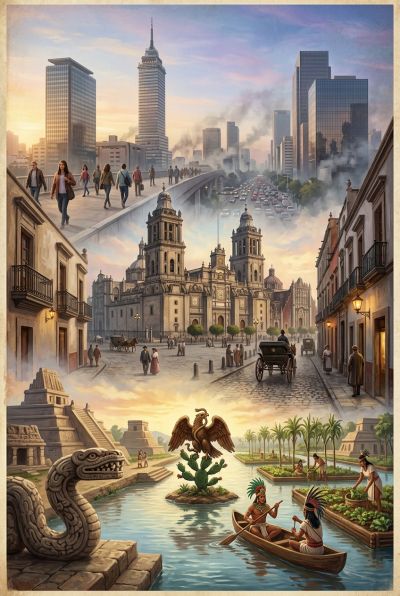
There's something uniquely intoxicating about a book that doesn't just tell a city's story, but shows you how its history has been physically embedded in its architecture, its canals, and its very soil. Alonso de Quintana's A History of Mexico City does exactly this, weaving seven centuries of narrative from Aztec prophecies to earthquake politics to argue that this metropolis lives and breathes its layered past in ways few other places do. It's a history that insists on walking its readers through the city's streets while explaining exactly where one might spot the ghost of a canal or the foundation stones of a demolished temple.
What the book is about
This is a comprehensive, nonfiction account of Mexico City from its pre-Columbian origins as Tenochtitlan to its current status as a global megalopolis. Organized into 25 chronologically arranged chapters, the book moves from the geological formation of the Valley of Mexico through the Aztec Empire, Spanish conquest, colonial period, independence struggles, and into the modern era's environmental and social challenges. The intended audience includes history enthusiasts, urbanists, and anyone curious about how geography, politics, and culture shape a city's identity. While it covers grand events like the fall of Tenochtitlan and the 1985 earthquake, the author deliberately gives equal weight to the "millions of anonymous inhabitants whose daily lives, struggles, and creativity have shaped this unique metropolis." The book balances academic rigor with accessible storytelling, offering both sweeping historical narratives and intimate glimpses of daily life through artifacts like market scenes and student protests.
History literally in the stones
Quintana emphasizes that Mexico City's history is "physically present, breaking through the surface of the contemporary world." The most striking example is how the Spanish Colonial Cathedral was literally built "over the ruins of the Aztec Sacred Precinct" using stones from demolished temples. This architectural superimposition wasn't just practical—it was deeply symbolic, creating a city where "the stones of demolished Aztec temples form the foundations of colonial cathedrals." Even today, the author notes, "ancient canals lie beneath modern streets," making the city a literal archaeological site. In Chapter Six, he describes how the very act of rebuilding after conquest created a permanent palimpsest: "To understand Mexico City is to understand a metropolis built in layers, a vast urban palimpsest where the past is not merely remembered but is physically present." This physical embedding of history becomes a central metaphor throughout, suggesting that residents unconsciously navigate a cityscape saturated with its own traumatic and triumphant memories.
Water and will: The city's defining dialectic
From its founding in the "lacustrine environment" to its modern water crisis, water serves as both Mexico City's greatest asset and its most persistent vulnerability. Quintana opens by describing the Valley of Mexico as a "landscape of lakes and volcanoes" where "a network of shallow, interconnected lakes shimmered across" before the Aztecs built their "Venice of the New World" on chinampas—artificial agricultural islands that were "not merely a farming method but... the primary means of urban expansion." The genius of Tenochtitlan was its ability to engineer with water, creating an aqueduct system so sophisticated it "provided a buffer against famine" and allowed the city to feed hundreds of thousands. But this relationship turned tragic under Spanish rule, when administrators viewed lakes primarily as "a nuisance—a source of flooding, mosquitoes, and miasmatic diseases." The colonial decision to fill in canals within the city center was the first step in what became a centuries-long war against water, culminating in the Porfirian drainage project that "created the physical and spiritual layering that defines the city to this day" but also set the stage for modern subsidence and scarcity. By Chapter Twenty-One, this theme reaches its culmination: the city that "built its foundations on the soft clay of the ancient lakebed" now faces the consequences of that geological gamble, sinking "by as much as 14 inches (35 centimeters) per year" as it pumps water from the very aquifer beneath its feet.
Synthesis and survival: The Virgin of Guadalupe
In exploring how cultures merged after conquest, Quintana identifies religious syncretism as both survival strategy and creative act. The story of the Virgin of Guadalupe represents "a unique and distinctly Mexican form of Catholicism" born when "the Virgin... appeared to a humble, recently converted Nahua man" on the hill of Tepeyac, which had "for centuries, been home to a major shrine dedicated to the Aztec mother goddess, Tonantzin." The Virgin's message was not a European import but a deeply Mexican revelation, speaking to Juan Diego "in their own language" and appearing as "a uniquely Mexican Madonna" with "the dark skin and indigenous features of the local people." This was not accidental blending but conscious adaptation: "Indigenous people, faced with the overwhelming power of the new rulers, did not simply abandon their ancestral beliefs. Instead, a complex and often subtle process of syncretism unfolded, in which old and new faiths blended, creating something entirely new." The Virgin became a bridge between worlds, transforming the site of indigenous worship into a Catholic sanctuary, but doing so in a way that honored local religious traditions rather than erasing them. This pattern of cultural fusion recurs throughout the book, from food to architecture to political identity.
From student massacre to earthquake resilience
The book treats the 1968 Tlatelolco Massacre and the 1985 earthquake as twin traumas that fundamentally altered the city's civic consciousness. In Chapter Eighteen, the massacre is described as occurring at the same plaza where Aztec warriors "had made their final, doomed stand against the Spanish conquistadors in 1521"—creating a place where "symbolism that no one could have appreciated at the time" layered centuries of resistance. The government's response was "a chilling precedent" of cover-up and manipulation, with officials claiming only "29 people had been killed" while eyewitnesses estimated "between 300 and 400" deaths before imposing "an iron curtain of censorship and silence." Just decades later, the 1985 earthquake created a mirror response: when official rescue efforts failed, "an enormous and spontaneous civil society mobilized itself" with "neighbors forming human chains to clear rubble" and creating the legendary Topos rescue teams. The author notes these moments fundamentally shifted the city's relationship to authority: citizens learned they "did not need the government, and that, in a crisis, they could be the government." Both events demonstrated the same truth: beneath the city's stratified social order lies a deep capacity for collective action when institutions fail.
Urban tribes and the search for belonging
>It was this dense, layered, and endlessly stimulating reality—the constant, vibrant friction between the ancient and the hyper-modern, the local and the global, the high and the low—that had become the city's greatest cultural asset.
In the modern era, Quintana explores how the city's scale creates entirely new forms of community through what he calls urban tribes. The Tianguis Cultural del Chopo becomes a central gathering point where "punks, gothic subculture, metalheads, skaters, and Rastafarians" create "a living, breathing map of the city's subcultural geography." These aren't formal organizations but fluid networks offering "cultural refuge and aesthetic identity" in response to "the city's overwhelming scale." More significantly, the author traces how these youth cultures intersect with formal social movements. The #YoSoy132 student movement of 2012 shows how young people organized through "social media platforms like Twitter and Facebook" to challenge the PRI candidate and demand media democratization. Meanwhile, feminist organizing has transformed International Women's Day into the "largest and most militant annual protest in the capital," with women clad in purple and green bandanas taking over the city center. Even Superbarrio Gómez, a housing activist who dons "the red and yellow costume of a Lucha Libre wrestler" to fight evictions, represents this same search for identity and justice. These movements demonstrate that the city's contemporary energy comes not from top-down planning but from grassroots creativity and resistance.
The revolution in everyday spaces: From murals to museums
>The city that once looked to Paris for its culinary cues now sets its own trends, confident in the unique power and profound history of its own table.
Quintana traces how Mexico City evolved from a place seeking European validation to a confident cultural exporter. The muralist movement of the post-revolutionary period created an entirely new form of public art, with Diego Rivera painting "a perfect pair of concentric circles of mole sauce" that serve as "a perfect metaphor for the city's cuisine: the vibrant present nestled within the deep, dark, complex past." This revolutionary art didn't remain static; it catalyzed entirely new cultural forms. By the 1990s, artists like Gabriel Orozco were "abandoning the canvas and the pedestal altogether, turning their gaze to the street" with pieces like *La DS*—slashing a Citroën in half to create a "functionless racing form" that comments on modernism and speed. The arrival of galleries like Kurimanzutto and institutions like MUAC and Museo Jumex created a "new and vibrant ecosystem of independent, artist-run spaces" that cemented the city's position as a "global creative hub" where "a peasant from Oaxaca could dream of his children attending the magnificent new university" while internationally recognized artists exhibit in the same neighborhoods where their grandparents might have lived in vecindades. The rise of Mexican fine dining, exemplified by Enrique Olvera's Pujol and its "Mole Madre, Mole Nuevo" that "had aged for over 1,500 days," shows how even food became a form of cultural assertion that moves "beyond the heroic nationalism of the muralists" to explore more personal and global themes.
Who should read this Readers who enjoy immersive urban histories that blend the grand sweep of political narrative with intimate details of daily life will find this book deeply rewarding. Urban planners, historians, and anyone fascinated by how geography shapes destiny should find particularly rich material in the analysis of water systems, settlement patterns, and infrastructure challenges. However, readers seeking a quick overview or focusing primarily on biographical details of major historical figures may find the book's focus on urban processes rather than personalities unsatisfying. This is fundamentally a book about place—how a city's physical and cultural geography creates its character across centuries. Those looking for a traditional political biography or single-issue examination should look elsewhere, but readers ready to explore how millions of everyday decisions create the texture of urban life will discover a masterful guide.
Read “A History of Mexico City” on MixCache.com →
Please log in or create an account to leave a comment.
No comments yet. Be the first to say something.