

A Journey Through Iraq's Crucible of Civilization and Conflict
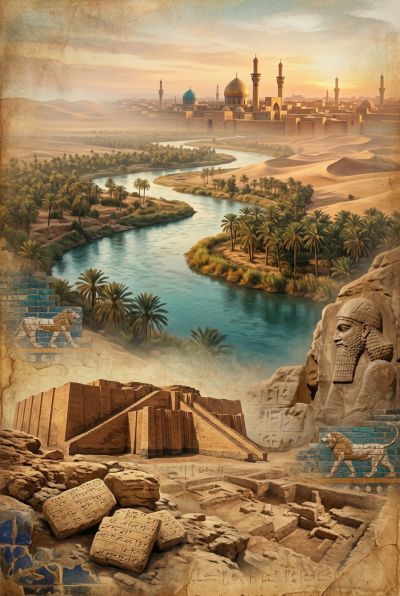
Ruben Masri's Geschichte des Irak offers a sweeping narrative that spans from the dawn of civilization to the complexities of modern geopolitics. This book invites readers to explore a land both foundational and fractured, where the Tigris and Euphrates rivers have long shaped not just agriculture but the rise and fall of empires.
The book is a comprehensive historical account divided into 25 chapters, beginning with an introduction that positions Iraq as "the story of humanity itself." Masri structures the narrative chronologically, moving from the Ubaid and Uruk periods through the rise of Islam, the Ottoman era, British mandate, Ba'ath Party rule, and into the 21st century. Each chapter delves deeply into specific epochs, providing detailed analysis of political, social, and cultural transformations. The intended audience includes readers interested in Middle Eastern history, political science, and those seeking to understand the roots of contemporary conflicts in the region.
The Eternal Cycle of Rise and Fall
Masri frames Iraq's history as a relentless cycle of "Innovation, imperialem Aufstieg und dramatischem Niedergang" (innovation, imperial rise, and dramatic downfall). This pattern emerges clearly in the ancient chapters, where the Akkadian Empire's swift expansion and collapse under external pressures mirrors later dynasties. The author highlights how Sargon's "erste Weltreich schufen" (first world empire) eventually succumbed to internal strife and ecological challenges, a narrative that echoes through millennia. This cyclical perspective suggests that Iraq's repeated cycles of flourishing and destruction are not merely historical accidents but deeply embedded in its geographic and political realities.
Geography as Destiny
The physical landscape is a constant character in Masri's narrative. He emphasizes how "Die Geographie des Irak ist der erste und wichtigste Charakter in seiner Geschichte" (The geography of Iraq is the first and most important character in its history). The fertile plains between the Tigris and Euphrates enabled early urban civilization, yet the same rivers and surrounding deserts also made the region vulnerable to invasion and control. This duality—"Lebensader" (lifelines) and "Heerstraßen für Armeen" (military highways)—shapes every layer of Iraq's story, from the Mongol invasions to modern oil geopolitics. Masri uses this geographic lens to explain both the creative and destructive forces that have molded the nation.
The Oil Curse and Modern Instability
Starting with the discovery of oil in 1927, Masri traces how "Öl brachte Reichtum, Modernisierung und immense strategische Bedeutung" (oil brought wealth, modernization, and immense strategic significance) while also becoming a source of endless conflict. The British mandate period is portrayed as a "künstliche Schöpfung des 20. Jahrhunderts" (20th-century artificial creation), where arbitrary borders ignored ethnic and religious divisions. The book meticulously details how oil revenues under Saddam Hussein fueled both authoritarianism and international confrontation, leading to the Iran-Iraq War and Gulf Wars. Masri argues that Iraq's modern political fragility stems directly from its petroleum wealth, which has perpetuated a system where "die Töchter des Volkes immer noch in Armut verharren" (the daughters of the people still remain in poverty) while elites enrich themselves.
Paradoxes of a Foundational Yet Troubled Land
Masri repeatedly returns to Iraq's central paradox: it is simultaneously "Wiege der Zivilisation" (cradle of civilization) and "wiederholter Kriegsschauplatz" (repeated battlefield). The introduction notes how the region gave humanity writing, law, and urban life, yet also endured "ein Kataklysmus, von dem sich der Irak jahrhundertelang nicht vollständig erholen sollte" (a catastrophe from which Iraq couldn't recover for centuries). This contradiction surfaces repeatedly—from Baghdad's medieval "Golden Age" of learning to its 13th-century sacking, from the 2003 invasion's "Mutter aller Schlachten" (mother of all battles) rhetoric to the subsequent civil war. The author presents these contradictions not as anomalies but as essential features of Iraq's enduring identity.
The Resilience of Ordinary Iraqis
Amidst the political upheavals, Masri consistently highlights the endurance of everyday Iraqis. In the final chapter, he writes of "Demonstranten, Künstler, Unternehmer und Bürgeraktivisten" (demonstrators, artists, entrepreneurs, and civic activists) who "weiterhin Rechenschaft und eine bessere Zukunft fordern" (still demand accountability and a better future). Even during the brutal sanctions period, the book acknowledges how "das Leben in der Metropole lebendig und vielfältig" (life in the metropolis remained alive and diverse), with people maintaining cultural and social practices despite hardship. This focus on grassroots resilience provides a counterpoint to the cycles of elite-driven destruction and offers a more hopeful lens through which to view Iraq's future.
Who should read this? This book demands careful, engaged reading. It's ideal for readers seeking a deep, nuanced understanding of Middle Eastern history beyond headlines, particularly those interested in how ancient geography and resources shape modern politics. Academics, students, and informed general readers will appreciate its thorough research and balanced perspective. Casual readers might find it dense, but anyone curious about the roots of Iraq's contemporary challenges—from sectarian violence to oil politics—will discover essential insights in Masri's comprehensive and compelling narrative.
Read “Geschichte des Irak” on MixCache.com →
Please log in or create an account to leave a comment.
No comments yet. Be the first to say something.