
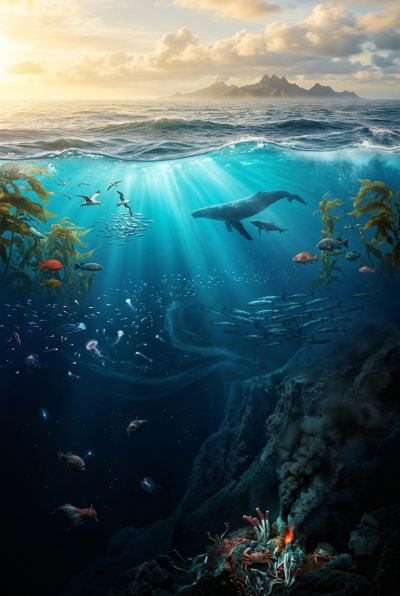
The Pacific is not just a book—it's a deep dive into the beating heart of Earth. In an era when climate change and ecological collapse dominate headlines, this portrait of the Pacific offers both a stark warning and a reminder of the ocean's wonder. Dr. Alex Bugeja has crafted an ambitious work that moves seamlessly from the ocean’s ancient past to its precarious future.
The Pacific: Portrait of an Ocean is a sweeping examination of the world’s largest body of water, structured as a journey through time and space. The book is organized into twenty-five chapters that blend geological history, human exploration, ecological science, and contemporary policy debates. Its intended audience spans readers curious about natural science, history, and environmental stewardship—anyone seeking to understand how the Pacific shapes our planet and our lives. From the breakup of supercontinents to the Great Pacific Garbage Patch, Bugeja charts a comprehensive course across disciplines.
The Geological Drama of Ocean Birth
Bugeja opens with a geological saga that reads like epic poetry. He begins with Rodinia, a billion-year-old supercontinent, and traces the Pacific’s origins to the opening of Panthalassa, its ancient ancestor. The book’s early chapters explain plate tectonics through the lens of the Pacific Plate, the largest tectonic slab on Earth. The East Pacific Rise, where “the plates are moving apart at a rate of over 15 centimeters (6 inches) per year,” is presented as a “geological conveyor belt” forging new seafloor. This foundational science sets the stage for understanding the ocean’s restless energy, from volcanic hotspots like Hawaiʻi to the subduction zones that create the Ring of Fire.
The Human Imprint: Voyagers and Empires
The book’s most compelling narrative threads are those of human interaction with the Pacific. Chapter Five, “The Voyagers,” tells how Polynesian navigators used “stick charts” and celestial knowledge to settle Remote Oceania. These ancient mariners, Bugeja writes, turned the Pacific “not into a barrier, but into a highway.” The contrast with European exploration in later chapters is striking. Bugeja recounts Magellan’s “Peaceful Sea” moniker as a “misnomer” given the ocean’s Ring of Fire—a detail that underscores how perception and reality diverge. The Manila Galleons and their role in creating the first global trade network illustrate how the Pacific became a stage for both cultural exchange and exploitation.
The Climate Engine: ENSO and Global Weather
Bugeja devotes significant space to the Pacific’s role as a climate engine, particularly the El Niño-Southern Oscillation (ENSO). He describes El Niño as a “sloshes eastward across the ocean basin like water in a bathtub,” disrupting weather patterns worldwide. The Great Ocean Conveyor, a deep-water current system, is likened to a “planetary-scale radiator” that regulates global temperatures. These climatic forces are not abstract; they shape monsoons, wildfires, and hurricanes. Bugeja’s explanation of how ENSO acts as “the planet’s premier source of year-to-year climate variability” makes the Pacific’s influence tangible for readers unfamiliar with ocean-atmosphere interactions.
The Fragile Kingdoms: Coral Reefs and Kelp Forests
The book’s ecological chapters reveal the Pacific’s biodiversity hotspots and their vulnerabilities. Bugeja labels coral reefs “the rainforests of the sea,” noting their role as home to “25 percent of all marine species.” The mechanism of coral bleaching is laid bare: when water temperatures rise, the symbiotic algae within corals “produce reactive oxygen species that are toxic to the coral.” The kelp forests of the Eastern Pacific are another focus, with their “three-dimensional structure” providing habitat for countless species. The sea otter’s role as a “keystone species” in controlling sea urchin populations demonstrates how fragile these ecosystems are to top-down disruption.
The Modern Menace: Plastic and Geopolitical Tensions
The Pacific’s contemporary challenges are addressed with urgency. The Great Pacific Garbage Patch, while “not a single, cohesive structure,” is “a vast, diffuse region of the ocean” where microplastics outnumber plankton. Bugeja details how this “slurry of tinier particles” enters the food web, with “zooplankton…ingesting these plastic particles” as a “man-made ark” for invasive species. Equally pressing are geopolitical tensions, particularly China’s artificial island-building in the South China Sea, which has transformed submerged reefs into strategic assets. These chapters illustrate how human activity has transformed the ocean into a geopolitical and ecological battleground.
Guardians of Hope: Conservation and Indigenous Wisdom
Despite the grim outlook, Bugeja highlights paths forward. The revival of traditional practices like Fiji’s “Locally Managed Marine Areas” (LMMAs) is framed as a bridge between “ancient voyaging techniques” and modern conservation. The book praises nations like Palau, which established “the world’s first national shark sanctuary,” and the “Pacific’s large ocean states” using their “moral authority” to demand global climate action. Technology also offers hope: satellite monitoring and autonomous vehicles are “transforming our ability to manage its resources.” The future “will be determined by a change not just in our policies and technologies, but in our perception” of the ocean as a living entity, not a commodity.
Who should read this: Readers fascinated by the intersection of natural science, human history, and environmental policy will find The Pacific a compelling and educational journey. Those seeking a straightforward travelogue or a light introduction to oceanography may find its depth and scope overwhelming. The book’s strength lies in its ability to connect complex scientific concepts to tangible human and ecological outcomes, making it a valuable resource for students, educators, and policy-minded individuals.
Read “The Pacific” on MixCache.com →
Please log in or create an account to leave a comment.
No comments yet. Be the first to say something.