

An Excerpt from “A History of Tourism”
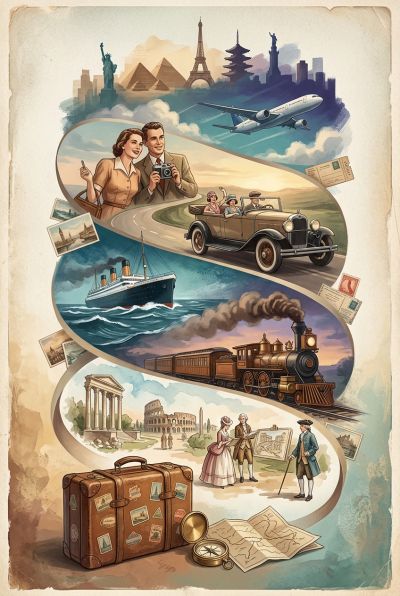
The following is an excerpt from “A History of Tourism” by John Howell, available on MixCache.com.
Introduction
The urge to leave home, to see what lies beyond the horizon, is a fundamentally human impulse. It is a desire that has manifested in countless ways throughout history, from the earliest migrations in search of food and safety to the modern-day pursuit of leisure and enlightenment. This book, A History of Tourism, is an exploration of that impulse and the myriad ways it has shaped societies, economies, and individual lives. But what exactly is tourism? At its core, it is the act of spending time away from home in pursuit of recreation, relaxation, and pleasure, often utilizing commercial services. It is a phenomenon distinct from mere travel, which can be undertaken for any number of reasons, from trade to warfare to exile. Tourism implies a journey with a purpose of enjoyment, a temporary sojourn into a world outside of one’s everyday routine.
The word "tourist" itself is a relatively modern invention, first appearing in English in 1772, with "tourism" following in 1811. These terms derive from the word "tour," which has its roots in the Latin tornare, meaning "to turn on a lathe," suggesting a circular journey, a departure and a return to the point of origin. This concept of a round-trip journey for pleasure is central to our understanding of tourism. While the terminology may be recent, the practice is as old as civilization itself. The wealthy of ancient Egypt traveled the Nile to witness religious festivals and marvel at the tombs of the pharaohs. In ancient Greece, people undertook pilgrimages to sacred sites like the Oracle at Delphi. The Romans, with their extensive network of roads and relative peace, saw the flourishing of leisure travel to coastal resorts and villas in places like Pompeii and Baiae. These early forms of tourism, though accessible only to a privileged few, laid the groundwork for what was to come.
For much of history, long-distance travel was an arduous and often perilous undertaking, reserved for soldiers, merchants, missionaries, and pilgrims. The Middle Ages saw a surge in religious pilgrimage, with Christians flocking to sites in Jerusalem and Santiago de Compostela, and Muslims to Mecca. These journeys, while deeply spiritual, also necessitated the development of infrastructure to support travelers, such as inns and taverns along well-trodden routes. However, it was not until the 17th century that a new form of travel emerged, one that was explicitly for the purpose of education and cultural enrichment: the Grand Tour. This extended journey across Europe, undertaken by young, upper-class European men, became a rite of passage. Lasting for months or even years, the Grand Tour was designed to expose these men to the cultural legacy of classical antiquity and the Renaissance. They would visit iconic cities like Rome, Florence, and Venice, studying art, architecture, and languages, all while participating in the fashionable society of the continent.
The true catalyst for the democratization of travel, however, was the Industrial Revolution of the 18th and 19th centuries. The advent of the railway and the steamship dramatically altered the landscape of travel, making it faster, safer, and, crucially, more affordable. This period saw the rise of a new middle class with disposable income and, for the first time, designated leisure time, including paid vacations. It was in this environment that a pivotal figure in the history of tourism emerged: Thomas Cook. In 1841, this English Baptist preacher organized a train excursion for a temperance meeting, an event now widely regarded as the first publicly advertised excursion train in England. This humble beginning launched a tourism empire. Cook pioneered the concept of the package tour, bundling transportation, accommodation, and meals into a single, affordable price. He introduced traveler's cheques, hotel coupons, and the first travel guidebooks, revolutionizing the travel industry and making it accessible to a far broader audience.
The 20th century witnessed a further explosion in tourism, fueled by the development of the automobile and, later, commercial air travel. The car offered unprecedented freedom and flexibility, giving rise to the road trip and the exploration of one's own country. But it was the arrival of the passenger aircraft in the mid-20th century that truly shrank the globe. The introduction of commercial jetliners in the 1950s drastically reduced travel times and costs, making international destinations that were once the exclusive domain of the wealthy accessible to the masses. The post-World War II economic boom in many Western countries created a surge in mass tourism, with millions of people eager to explore the world. This era saw the rise of the beach holiday, the ski resort, and the package holiday to sun-drenched destinations.
As tourism has grown, it has also diversified. From the counter-cultural backpacker trails of the 1960s and 70s to the rise of ecotourism and the search for sustainable travel, the motivations and methods of travelers have continued to evolve. The digital age has brought about yet another revolution, with the internet reshaping how we research, book, and experience travel. The rise of low-cost carriers has further democratized air travel, while the phenomenon of the "digital nomad" has blurred the lines between work and leisure. Today, the tourism industry is a global behemoth, a significant contributor to the economies of many nations and a powerful force for cultural exchange. However, its rapid growth has not been without consequences. Issues of overtourism, environmental degradation, and the commodification of culture have become increasingly pressing concerns. Global crises, from pandemics to political conflicts, have also demonstrated the industry's vulnerability.
This book will chart the course of this remarkable journey, from its ancient origins to its complex present and its uncertain future. We will explore the motivations that have driven people to travel, the technological innovations that have made it possible, and the social, economic, and environmental impacts it has had along the way. From the solitary pilgrim on a dusty road to the modern-day tourist snapping a selfie in a crowded square, the story of tourism is ultimately the story of our enduring fascination with the world beyond our own doorstep. It is a story of discovery, of connection, and of the profound and often contradictory ways in which we seek to understand our planet and our place within it.
Read “A History of Tourism” on MixCache.com →
Please log in or create an account to leave a comment.
No comments yet. Be the first to say something.