

An Excerpt from “A History of the United Arab Emirates”
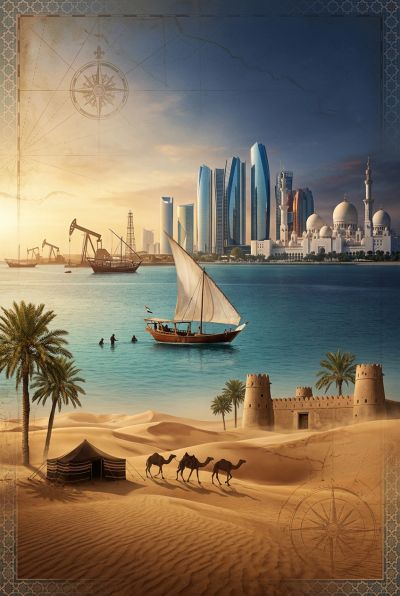
The following is an excerpt from “A History of the United Arab Emirates” by Ahmed Hassan, available on MixCache.com.
Introduction
To the casual observer, the United Arab Emirates presents a dazzling mirage of modernity. It is a land of superlatives: the world's tallest building piercing the sky above Dubai, sprawling man-made islands sculpted in the shape of palm trees, and futuristic cities rising from the desert sands. This image, of a nation seemingly born of oil wealth and boundless ambition, has captured the global imagination. It’s a narrative of astonishingly rapid transformation, a story of how, in the span of a single lifetime, a collection of quiet coastal sheikhdoms became a global hub for finance, trade, and tourism. Yet, this popular narrative, compelling as it is, tells only the final, breathless chapter of a much longer, richer, and more complex story.
This book is about the chapters that came before. It is an exploration of the deep historical currents that flow beneath the shimmering surface of the modern UAE. The story of this land did not begin with the discovery of oil in the mid-20th century, any more than the history of a great river begins at the delta where it meets the sea. To truly understand the Emirates, one must journey back not just decades, but millennia. We must look to a time when its inhabitants drew their livelihood not from petroleum, but from the pearl beds of the Persian Gulf, and navigated their world not by GPS, but by the stars that glittered over the vast, silent expanse of the Rub' al Khali, the "Empty Quarter."
Our journey begins in the distant past, in an era accessible only through the patient work of archaeologists. Evidence suggests human habitation in this region for over 125,000 years, with ancient peoples leaving behind faint but tantalizing traces of their existence. These early inhabitants were followed by sophisticated Bronze Age cultures that established trade links with the great civilizations of Mesopotamia and the Indus Valley. The land that is now the UAE has always been a crossroads. Its strategic location on the Arabian Peninsula, nestled between the Persian Gulf and the Gulf of Oman, has made it a nexus for maritime trade and cultural exchange for thousands of years. Empires have cast their shadows here—from the Achaemenids of Persia to the successors of Alexander the Great—each leaving their mark on the cultural and political landscape.
Long before the formation of a unified nation, life in this region was defined by two powerful forces: the sea and the desert. Along the coast, communities thrived on the bounty of the Gulf. For centuries, fishing and, most importantly, pearling, formed the backbone of the economy. This was a perilous and demanding existence, one that forged resilient, tight-knit communities with a deep understanding of the maritime world. Their wooden dhows, with their distinctive lateen sails, were a common sight along the trade routes, connecting the Arabian coast to Persia, India, and the shores of East Africa. This maritime dominance was a source of both wealth and conflict, leading to encounters with European powers like the Portuguese and, eventually, the British, who sought to control the vital sea lanes to India.
Inland, away from the humid coast, a different way of life unfolded in the oases and the vast desert plains. Here, nomadic Bedouin tribes, masters of survival in an unforgiving environment, moved with the seasons in search of pasture for their camels and goats. Their culture was built on principles of hospitality, honor, and a deep loyalty to the clan and tribe. The tribe was the fundamental unit of social and political organization, a web of kinship that provided security and identity. Leadership fell to the sheikhs, who ruled not by absolute decree but through consultation, wisdom, and the ability to mediate disputes. This tribal structure, with its emphasis on consensus and personal allegiance, would prove to be an enduring feature of the region's political life, shaping the very foundation of the future federation.
The arrival of Islam in the 7th century profoundly reshaped the identity of the peninsula, integrating the local tribes into the broader Arab and Islamic world. The centuries that followed were marked by the rise and fall of local powers, most notably the formidable Qawasim, a maritime force that challenged even the British Royal Navy for control of the Gulf's waters in the 18th and early 19th centuries. It was this conflict that ultimately led to direct British intervention and the signing of a series of treaties, beginning with the General Maritime Treaty of 1820. These agreements, designed to suppress piracy and ensure maritime peace, effectively placed the coastal sheikhdoms under British protection, giving rise to the name by which they would be known for the next 150 years: the Trucial States.
For much of the British era, the Trucial States remained a collection of small, autonomous sheikhdoms, their internal affairs largely left to the rulers so long as the peace at sea was maintained. The economy continued to be dominated by the rhythms of the pearling industry, a trade that brought moments of prosperity but was also vulnerable to the whims of international markets. The collapse of the pearling market in the early 20th century, brought on by the advent of cultured pearls from Japan and the global shock of the Great Depression, plunged the region into a period of severe economic hardship. It was a time of immense struggle, a stark reminder of the precariousness of their traditional way of life.
The turning point, the catalyst that would irrevocably alter the destiny of the Trucial States, lay hidden deep beneath the desert sands. Geological surveys began in the 1930s, and after decades of searching, the first commercially viable oil reserves were discovered. The first cargo of crude oil was exported from Abu Dhabi in 1962, and with it, the seeds of a new future were sown. The newfound oil wealth provided the means for transformation, but it was the vision of the region's leaders that would give it shape and direction. At the forefront of this new era was Sheikh Zayed bin Sultan Al Nahyan, who became Ruler of Abu Dhabi in 1966. He understood that the oil revenues were not an end in themselves, but a tool to build a modern, stable, and prosperous society for his people.
The final impetus for nationhood came in 1968, when Britain announced its intention to withdraw its military and political presence from the Gulf by the end of 1971. This declaration created a political vacuum and a period of uncertainty. Faced with the challenges of independence, Sheikh Zayed, alongside Sheikh Rashid bin Saeed Al Maktoum of Dubai, championed the idea of a federation. It was a revolutionary concept: to unite the fiercely independent emirates into a single, sovereign state. After complex negotiations, on December 2, 1971, six of the seven Trucial States—Abu Dhabi, Dubai, Sharjah, Ajman, Umm Al Quwain, and Fujairah—came together to form the United Arab Emirates. The seventh, Ras Al Khaimah, joined the federation in early 1972.
This book traces this remarkable historical arc in chronological order. We will begin by sifting through the archaeological evidence of the earliest inhabitants, moving through the Bronze and Iron Ages to understand the foundations of trade and settlement. We will examine the influence of pre-Islamic powers, the transformative arrival of Islam, and the era of European exploration. The narrative will then delve into the rise of the Qawasim, the establishment of the Trucial States under British treaties, and the intricacies of the pearling economy that sustained the region for centuries. From there, we will chart the decline of pearling, the pivotal search for and discovery of oil, and the dawn of a new age of development. The final chapters will focus on the crucial moments leading to the British withdrawal and the formation of the Union in 1971, the visionary leadership of Sheikh Zayed, and the subsequent decades of explosive growth that have placed the UAE on the world stage.
This is not simply a story of oil, but a story of people and their enduring relationship with a unique and challenging landscape. It is a history of adaptation, of resilience in the face of scarcity, and of the ability to seize opportunity in times of dramatic change. It is an account of how a society deeply rooted in the traditions of the tribe and the sea navigated the currents of modernity to create something entirely new. The glittering towers of Dubai and Abu Dhabi may be the most visible symbols of the UAE today, but their foundations were laid long ago, in the pearling dhows, the desert oases, and the timeless traditions of the people who have called this land home for millennia.
Read “A History of the United Arab Emirates” on MixCache.com →
Please log in or create an account to leave a comment.
No comments yet. Be the first to say something.