

An Excerpt from “A History of the Czech Republic”
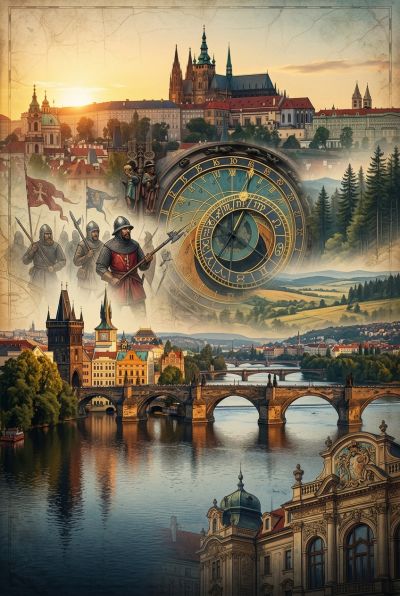
The following is an excerpt from “A History of the Czech Republic” by Tomáš Novák, available on MixCache.com.
Introduction
To understand the Czech Republic, one must first understand its geography, which is to say, its predicament. Landlocked and lodged in the very center of Europe, the nation has often been called the "Heart of Europe." This is a lovely and poetic appellation, suggesting a vital organ pumping lifeblood through the continent. It is also a rather precarious place to be. A heart is vulnerable, and a crossroads is a place where traffic, both welcome and unwelcome, is constant. For over a millennium, the story of the Czech lands—comprising the historical territories of Bohemia, Moravia, and part of Silesia—has been one of absorbing influences, repelling invaders, and navigating the treacherous currents of a continent in perpetual motion.
This book is a journey through that tumultuous and fascinating history. It is the story of a place that has been a kingdom, a jewel of the Holy Roman Empire, a hotbed of religious reformation, a province of the Habsburgs, a cornerstone of twentieth-century democracy, a victim of Nazi aggression, a satellite of the Soviet Union, and finally, a modern, independent republic. It is a history marked by golden ages of cultural and political influence, as well as by dark periods of war, oppression, and foreign domination. Through it all, a distinct identity has been forged, one that is resilient, creative, often skeptical, and possessed of a unique and enduring spirit.
The narrative of this land is not a simple, linear progression. It is a complex tapestry woven from the threads of Slavic, Germanic, and Jewish cultures. Its borders have shifted, its name has changed, and its people have spoken different languages and answered to different rulers. The modern Czech Republic is a nation-state, but its history is that of a multinational, multicultural heartland. To trace its story is to trace the major convulsions of European history itself, from the medieval clashes of emperors and popes to the ideological battles of the twentieth century. This is not just the history of a small country; it is a history of Europe in miniature.
The tale begins long before the first Czechs, with Celtic and Germanic tribes roaming the forested hills and fertile plains. The name "Bohemia," the largest of the Czech lands, is a legacy of a Celtic tribe, the Boii. But it was the arrival of Slavic tribes in the sixth century that laid the foundation for the nation to come. From these early settlements, a state would gradually cohere, first under the shadowy figure of Samo, then more concretely in the Great Moravian Empire, a powerful but short-lived entity that saw the arrival of Christianity. It was here that the foundational myths were born, of legendary rulers and the establishment of a dynasty—the Přemyslids—that would guide the nascent state for centuries.
The medieval Kingdom of Bohemia would rise to become a significant power, its kings playing a crucial role in the politics of the Holy Roman Empire. Prague, the "City of a Hundred Spires," would become an imperial capital under the reign of Charles IV in the fourteenth century, a golden age that saw the founding of the first university in Central Europe and a flourishing of art and architecture. Yet this era of stability and prestige also sowed the seeds of conflict. Religious and social tensions boiled over in the early fifteenth century with the Hussite movement, a revolutionary storm that challenged the authority of both the Pope and the Holy Roman Emperor, making Bohemia a bastion of reformation a full century before Martin Luther.
The defeat of the Protestant Czech estates at the Battle of White Mountain in 1620 was a watershed moment. It ushered in three centuries of rule by the Habsburg dynasty from Vienna, a period characterized by forceful re-Catholicization and Germanization. Yet it was not a period of simple subjugation. The Baroque culture of the Habsburg Empire left a stunning architectural legacy on the landscape, and the Czech language and culture, while suppressed, were never extinguished. Instead, they went into a long hibernation, nurtured by rural communities and a handful of intellectuals.
This cultural slumber gave way to a "National Revival" in the nineteenth century. As industrialization transformed Bohemia and Moravia into the economic engine of the Austro-Hungarian Empire, a new confidence emerged. Linguists, historians, composers, and politicians worked to resurrect a distinct Czech identity, paving the way for a renewed push for political autonomy. The collapse of the old empires in the crucible of the First World War finally provided the opportunity, and in 1918, the independent state of Czechoslovakia was born, uniting Czechs and Slovaks in a democratic republic that became a beacon of stability and prosperity in interwar Europe.
This hopeful experiment was tragically short-lived. Betrayed at Munich in 1938 and subsequently occupied by Nazi Germany, Czechoslovakia endured six years of brutal oppression. Liberation in 1945 brought not a return to freedom, but a slide into a new form of tyranny. A Communist coup in 1948 pulled the nation behind the Iron Curtain, beginning four decades of one-party rule, political persecution, and economic stagnation under the shadow of the Soviet Union. A brief, intoxicating moment of liberalization in 1968, known as the Prague Spring, was crushed by Warsaw Pact tanks, leading to a long period of demoralizing "normalization."
The end, when it came, was astonishingly swift. The non-violent Velvet Revolution of 1989 swept away the Communist regime in a matter of weeks, a testament to the enduring desire for freedom. The years that followed were a whirlwind of change: the re-establishment of democracy, a transition to a market economy, and, in 1993, the peaceful dissolution of Czechoslovakia into two separate nations, the Czech Republic and Slovakia, in what became known as the "Velvet Divorce."
The story this book will tell is guided by several recurring themes. The first is the sheer persistence of a national identity in the face of overwhelming pressure. Time and again, Czech culture has been threatened with absorption by more powerful neighbors, yet it has survived, often by turning inward, by cultivating its language and traditions, and by employing a particular brand of passive resistance and dark humor.
Another key theme is the nation's complex and often fraught relationship with its neighbors, particularly the Germans. For centuries, Czech and German speakers lived side by side, their cultures intertwining in the cities and towns of Bohemia and Moravia. This coexistence was at times productive and at others deeply antagonistic, culminating in the tragic events of the twentieth century: the Nazi occupation and the subsequent expulsion of the Sudeten Germans after the Second World War. This relationship remains a sensitive and defining aspect of the Czech historical experience.
Finally, this is a story of cycles of creative explosion and political crackdown. The golden age of Charles IV was followed by the Hussite Wars. The vibrant democracy of the First Republic was extinguished by the Nazis. The artistic and intellectual ferment of the 1960s was crushed by Soviet tanks. Yet, in each instance, the cultural and intellectual embers were kept alive, ready to reignite when the political climate allowed. This rhythm of flourishing and suppression, of hope and disillusionment, is central to the Czech story.
From the Přemyslid princes to the Habsburg emperors, from the reformer Jan Hus to the playwright-president Václav Havel, this history is populated by remarkable individuals who shaped the destiny of their nation and, at times, the continent. It is a story reflected in the magnificent architecture of Prague's Old Town Square, the solemn castles dotting the countryside, and the stark concrete housing blocks of the Communist era. It is a history whose legacy is a nation that is at once deeply rooted in the heart of Europe and still charting its course in a new millennium. This book aims to bring that rich, complex, and deeply human story to life.
Read “A History of the Czech Republic” on MixCache.com →
Please log in or create an account to leave a comment.
No comments yet. Be the first to say something.