

An Excerpt from “A History of Taxes and Taxation”
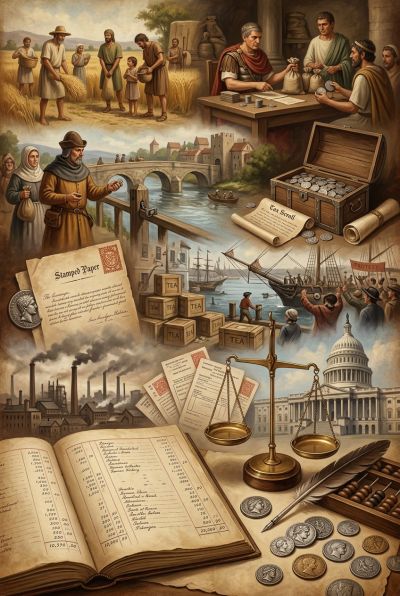
The following is an excerpt from “A History of Taxes and Taxation” by Paul Cilia, available on MixCache.com.
Introduction
“Our new Constitution is now established, and has an appearance that promises permanency,” wrote Benjamin Franklin in a 1789 letter to the French scientist Jean-Baptiste Leroy, “but in this world nothing can be said to be certain, except death and taxes.” While Franklin is famously credited with the observation, he was not its originator; variations of the phrase had been circulating for decades, a testament to its self-evident truth. Death is the inevitable end of every individual life. Taxes, it seems, are the inevitable price of collective life, the enduring mark of civilization itself. They are the membership dues for belonging to an organized society, a concept as old as the first settled communities that needed to fund shared projects and provide for common defense.
The story of taxation is, in many ways, the story of humanity’s ongoing, often contentious, effort to figure out how to live together. It is a narrative woven into the very fabric of history, etched onto 5,000-year-old Sumerian clay tablets and encoded in the blockchain of the 21st century. The earliest known records of taxation come from ancient Egypt, around 3000 BCE, where pharaohs would conduct regular tours of the kingdom to assess and collect levies on grain, livestock, and even cooking oil. In a world without coined money, grain served as a tangible store of value, easily collected and redistributed to support the state's endeavors. These early levies were essential for monumental public works, such as the construction of pyramids and temples, and for sustaining the machinery of government.
But what, precisely, is a tax? The word itself derives from the Latin taxare, meaning to appraise or to assess. A tax is a mandatory financial charge or some other type of levy imposed upon a taxpayer by a governmental organization in order to fund government spending and various public expenditures. This compulsory nature distinguishes a tax from a voluntary contribution or a gift. History, however, presents a more complex tapestry of terms and obligations. We see tributes paid by one ruler or nation to another, often to avoid conflict. We see tithes, a one-tenth portion of produce or income, given to a religious institution, sometimes voluntarily, sometimes as a compulsory obligation enforced by ecclesiastical or secular law. There are also feudal dues, where labor or goods were rendered to a lord in exchange for protection and the right to work the land.
While the specific names and justifications have varied across cultures and epochs, the underlying principle remains remarkably consistent: the transfer of private resources to a central authority for a common purpose. Whether it was grain for the pharaoh's granaries, salt for the French king's coffers, or dollars for a modern nation's treasury, the goal has been to pool resources for activities that individuals could not undertake alone. The history of these distinctions is not merely academic; the perceived difference between a just tax and an oppressive tribute has fueled countless conflicts. The line between a civic duty and an arbitrary expropriation is one that societies have drawn and redrawn throughout time, often in response to violent upheaval.
The fundamental "why" of taxation is tied to the evolution of the state itself. In their most basic form, taxes provide the revenue necessary for a government to function. Historically, the primary drivers of taxation have been the so-called "three W's": warfare, welfare, and public works. From the earliest empires to the modern nation-state, the need to fund a military has been a constant and powerful impetus for raising revenue. Wars are expensive, and governments have consistently turned to their populations to finance armies, navies, and fortifications. Indeed, many of the tax systems we are familiar with today have their origins in the exigencies of armed conflict.
Beyond defense, taxes have funded the creation and maintenance of vital economic infrastructure—roads, bridges, ports, and irrigation systems—that facilitate commerce and daily life. They have supported legal systems, public security, and the administration of government itself. In more recent centuries, the role of taxation has expanded significantly to include funding for public education, healthcare, social safety nets, scientific research, and cultural institutions. This expansion reflects a changing understanding of the state's responsibilities to its citizens, a shift from a primary focus on security to a broader concern for public welfare and human development.
Just as the reasons for taxation have evolved, so too have the methods. The "how" of taxation is a story of increasing sophistication, mirroring developments in administration, technology, and economic structure. The earliest and most straightforward levies were on tangible, easily identifiable assets. Taxes on land and agricultural produce were common in ancient civilizations from Mesopotamia and China to Egypt and Persia because land was the primary source of wealth and its output was relatively simple to measure. Another simple form of levy was the poll tax, or head tax, a fixed sum imposed on every individual. These taxes were administratively simple but often deeply inequitable, as they took no account of a person's ability to pay.
As economies grew and diversified, so did the tax base. The Romans, renowned for their administrative prowess, utilized a wide array of taxes, including customs duties on imports and exports, sales taxes, and inheritance taxes. The centesima rerum venalium, a one percent tax on goods sold at auction, instituted during the reign of Caesar Augustus, stands as an early forerunner of the modern sales tax. For a long period, the collection of these taxes was often outsourced to "tax farmers," private contractors who paid the state a lump sum for the right to collect taxes in a particular region, a system ripe for corruption and abuse.
The development of more complex forms of taxation required corresponding advances in state capacity. The introduction of the income tax, for example, presupposes a largely monetized economy, widespread literacy, and a sophisticated bureaucracy capable of assessing and collecting the tax. While an early form of income tax was established in China by Emperor Wang Mang in 9 BCE, it would be centuries before it became a mainstay of government revenue in the Western world, its birth largely a consequence of the immense financial pressures of the Napoleonic Wars. Similarly, the value-added tax (VAT), a cornerstone of modern public finance in many countries, is an administratively demanding tax that was only developed in the 20th century.
To view the history of taxation as a mere chronicle of evolving financial administration would be to miss its profound impact as a primary engine of historical change. The power to tax is one of the most fundamental and potent powers of any government, and disputes over its application have been at the heart of some of the most dramatic events in human history. Resentment over taxation has been a key ingredient in rebellions and revolutions across the ages. The Magna Carta, signed in 1215, was in large part a reaction by English barons to King John's arbitrary and excessive tax demands, establishing the principle that the king could not levy new taxes without the consent of the governed.
Centuries later, this same principle would echo across the Atlantic in the rallying cry of the American colonists: "No taxation without representation." The American Revolution was ignited not necessarily by the high rates of British taxes—colonists, in fact, paid considerably less in taxes than their counterparts in Great Britain—but by the principle that they were being taxed by a Parliament in which they had no elected representatives. The series of taxes imposed by the British to pay off debts from the Seven Years' War, such as the Stamp Act and the Tea Act, were seen as an unjust exercise of power, ultimately leading to the birth of a new nation. Similarly, the French Revolution was fueled by a deeply unfair tax system that largely exempted the nobility and clergy, placing the overwhelming burden on the common people.
These historical conflicts highlight the intimate connection between taxation and the concept of a "social contract." This philosophical idea, developed during the Enlightenment, posits that individuals tacitly agree to surrender some of their freedoms and submit to the authority of a government in exchange for the protection of their remaining rights and the provision of public goods. Taxation is the most tangible manifestation of this bargain. Citizens contribute a portion of their private assets to the commonwealth with the expectation that the government will, in turn, deliver on its obligations, creating a stable and prosperous society for all.
The nature of this fiscal social contract, however, has always been a subject of intense debate. What is the proper balance between individual liberty and collective need? What are the legitimate functions of the state that taxation should support? And how should the burden of paying for these functions be distributed among the populace? These are not merely technical questions of public finance; they are deeply moral and political questions that go to the heart of what a society values. Throughout history, the answers to these questions have varied enormously, reflecting the prevailing ideologies of the time.
The debate over what constitutes a "fair" tax is as old as taxation itself. In his seminal 1776 work, The Wealth of Nations, the Scottish economist and philosopher Adam Smith laid out four maxims, or principles, of good taxation that continue to influence policy discussions to this day: equity, certainty, convenience, and efficiency. The first, equity, holds that individuals should contribute to the support of the government in proportion to their respective abilities, that is, in proportion to the revenue they enjoy under the state's protection. This "ability-to-pay" principle has become a cornerstone of modern progressive tax systems, where tax rates increase as income rises.
Smith's other principles are more practical. Certainty means that the tax each individual is bound to pay ought to be clear and plain, not arbitrary. Convenience dictates that taxes should be levied at a time and in a manner that is most likely to be convenient for the contributor to pay. Finally, efficiency requires that a tax should be designed to take as little as possible from the people over and above what it brings into the public treasury, minimizing both administrative costs and negative economic effects. While these principles provide a useful framework, their interpretation and application have been a source of constant argument.
Indeed, the history of taxation is also a history of competing philosophies. Is the primary purpose of taxation simply to raise revenue, or should it be used as a tool to achieve broader social and economic goals? Should taxes be designed to be as neutral as possible, interfering with the market as little as possible? Or should they be used to encourage "good" behaviors (such as investing in green energy) and discourage "bad" ones (such as smoking or polluting)? Should the tax system actively seek to reduce economic inequality by redistributing wealth from the rich to the poor? There are no easy answers to these questions, and different societies have embraced vastly different approaches, from the high marginal tax rates of the post-World War II era to the supply-side tax cuts of the 1980s.
This book will trace the long and fascinating history of these ideas and practices, following the chronological and thematic roadmap laid out in the table of contents. Our journey will begin in the ancient river valleys of Mesopotamia and Egypt, where the first centralized states laid the groundwork for public finance. We will travel through classical Greece and Rome, examining their innovative, and sometimes brutal, systems of revenue collection. We will explore the role of tithes and tributes in the great Byzantine and Islamic empires, and the complex web of feudal dues that characterized medieval Europe.
The narrative will then follow the rise of modern states and the financial revolutions that accompanied them, from the city-states of Renaissance Italy to the burgeoning commercial empires of the Netherlands and England. We will witness how disputes over taxation kindled the fires of revolution in America and France, and how the unprecedented costs of total war gave birth to the modern income tax. The story will continue through the industrial age, the turmoil of the World Wars and the Great Depression, and the ideological clashes of the Cold War.
Finally, we will arrive in the present day, a world facing a host of new and complex challenges. How should governments tax the vast, borderless realm of the digital economy? How can the international community combat the proliferation of tax havens that erode the tax bases of nations rich and poor? And what does the future hold for taxation in an age of automation, cryptocurrency, and pressing environmental crises? The timeless questions of fairness, efficiency, and the social contract remain as relevant as ever, continuing to shape our politics, our economies, and our lives. The story of taxes is far from over; it is a human story that is constantly being written.
Read “A History of Taxes and Taxation” on MixCache.com →
Please log in or create an account to leave a comment.
No comments yet. Be the first to say something.