

An Excerpt from “A History of Macau”
The following is an excerpt from “A History of Macau” by Alfred Yang, available on MixCache.com.
Introduction
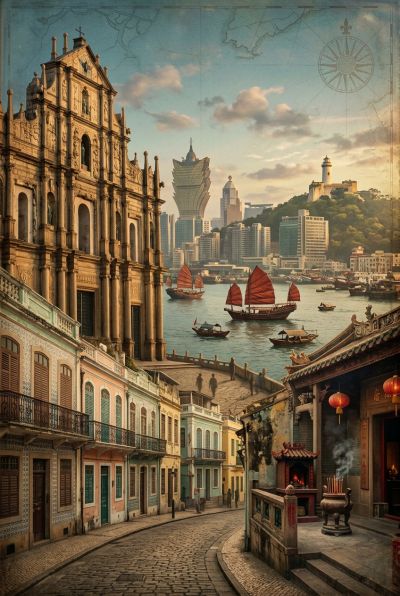
To gaze upon the Macau of the twenty-first century is to witness a city of dazzling contradictions. It is a place where the cacophony of casino floors, ringing with a thousand bets a second, exists just a few cobbled steps away from the serene silence of a centuries-old Catholic church. It is a skyline of audacious, glittering towers shaped like lotus flowers and phoenix feathers, a skyline that shadows the pastel-hued colonial villas and traditional Chinese shophouses below. Here, on a tiny peninsula and its adjoining islands at the mouth of China’s Pearl River, more money is wagered and won in a single week than in Las Vegas in a month, yet the city’s most famous landmark is the ghostly stone façade of a church that burned down in 1835. This is Macau: a city whose contemporary identity as the world's undisputed gaming capital is merely the latest chapter in a long, complex, and utterly unique history.
This book, ‘A History of Macau’, seeks to unravel that story. It is a narrative that stretches back far beyond the arrival of the first European ships, to a time when the peninsula was a sparsely populated coastline, known to Chinese fishermen and the occasional refugee fleeing turmoil on the mainland. Archaeological evidence points to human activity dating back thousands of years, but for much of its early existence, the area was a minor footnote in the grand chronicles of the Chinese dynasties, a remote part of Xiangshan County. It was a place of refuge, fresh water, and food for merchants sailing between Southeast Asia and the great port of Guangzhou (Canton). In 1277, it became a sanctuary for some 50,000 followers of the Southern Song dynasty, fleeing the Mongol conquest. They built temples, including one to A-Ma, the goddess of seafarers, from whose name—A-Ma-Gao, or "Bay of A-Ma"—the Portuguese would eventually derive the name "Macau". Yet, it remained a place of little consequence until the sixteenth century, when sails bearing the cross of the Order of Christ appeared on the horizon, heralding a profound and permanent transformation.
The arrival of the Portuguese in the 1550s was not an act of conquest in the typical colonial mold. Unlike other territories seized by European powers, Macau was acquired through a delicate and, for centuries, ambiguous arrangement with the Ming dynasty authorities. Seeking a permanent foothold for their lucrative trade in Chinese silks and Japanese silver, the Portuguese negotiated the right to establish a settlement. In exchange for an annual rent, initially 500 taels of silver, they were permitted to build and govern, creating the first European settlement in the Far East. This unique status—a lease, not a cession of sovereignty—defined Macau’s existence for over 400 years. It was a Chinese territory under Portuguese administration, a fine distinction that would be the source of both its enduring stability and occasional friction, a place where the authority of the local Senate and the Portuguese Governor coexisted with that of the mandarins of Guangdong.
This arrangement proved phenomenally successful. For a century, Macau blossomed into its Golden Age, becoming a vital linchpin in a global trading network that stretched from Lisbon to Goa, Malacca, and onward to Nagasaki in Japan. It was the primary funnel through which the silver of the New World, carried by Spanish galleons to Manila, flowed into China in exchange for the silks and porcelains coveted by the world. When Ming authorities, wary of piracy, banned direct trade with Japan, it was the Portuguese of Macau who became the indispensable middlemen, conducting the immensely profitable exchange of Chinese silk for Japanese silver. The city became a bustling, cosmopolitan port, its population a mix of Portuguese merchants and officials, Chinese farmers and artisans, Jesuit priests, and traders from across Asia, creating a unique cultural crucible.
Hand in hand with commerce came faith. Macau quickly became the principal base for the Catholic Church’s missionary efforts in East Asia. The Jesuit order, in particular, saw the city as a crucial gateway to the vast, untapped spiritual landscape of China and Japan. In 1594, they founded St. Paul's College, an institution that can be considered the first Western-style university in East Asia. It was a formidable center of learning, where missionaries like Matteo Ricci studied the Chinese language and culture before embarking on their journeys to the imperial court in Beijing. The college, with its vast library and printing press, became a hub for the exchange of scientific, astronomical, and philosophical knowledge between East and West. The magnificent stone façade of its adjoining church, all that remains today, stands as a powerful symbol of this era of profound cultural and religious encounter.
However, Macau's gilded prosperity was not to last. The decline of Portuguese maritime power, coupled with the rise of aggressive competitors like the Dutch, who unsuccessfully attempted to seize the city in 1622, began to erode its dominance. The expulsion of the Portuguese from Japan in the 1630s severed the lucrative silver-silk trade, a devastating blow from which the city's commercial fortunes never fully recovered. The establishment of the Canton System in the 18th century, which designated Guangzhou as the sole port for foreign trade, further marginalized Macau. Its role shifted from being the primary engine of trade to a more sedate, secondary base where foreign merchants were required to reside while awaiting the trading season in Canton. The city entered a long period of gentle decline, its grand colonial buildings a reminder of a more prosperous past.
The nineteenth century brought new challenges and transformations. The Opium Wars and the subsequent rise of British Hong Kong just across the estuary completely eclipsed Macau as the region's preeminent trading port. Faced with economic obsolescence, the Portuguese administration sought new sources of revenue. In a move that would define the city’s future trajectory, gambling was legalized in 1847. Initially a collection of traditional Chinese fantan houses, this nascent industry provided a much-needed economic lifeline. This era also saw Portugal assert more direct control, abolishing the Chinese customs house in 1849 and, in 1887, securing the Sino-Portuguese Treaty of Peking, which confirmed Portugal's right of "perpetual occupation and government" over Macau. Yet this was also a dark period, marked by the notorious "coolie trade," where indentured Chinese laborers were shipped from Macau to plantations across the world under often brutal conditions.
The twentieth century saw Macau navigate a series of global and regional upheavals with remarkable dexterity. During the Second World War, Portugal’s neutrality, respected by the invading Japanese, turned Macau into a haven in a war-torn region. While nearby Hong Kong and much of southern China suffered under Japanese occupation, Macau remained a neutral port, its population swelling with hundreds of thousands of refugees. This precarious neutrality came at a cost, with the city existing under Japan's virtual protectorate and subject to its influence, but it was spared the worst of the conflict. Following the establishment of the People's Republic of China in 1949, and later during the turmoil of the Cultural Revolution, Macau continued its delicate dance, a capitalist, colonial outpost on the edge of a communist giant, a place for quiet diplomacy and clandestine contact.
The final decades of Portuguese rule were defined by a gradual and peaceful process of decolonization. The 1974 Carnation Revolution in Portugal set in motion the end of its colonial empire, and Lisbon officially recognized Macau as a "Chinese territory under Portuguese administration". Following the successful negotiation for the handover of Hong Kong, China and Portugal began their own talks in 1986. These culminated in the 1987 Sino-Portuguese Joint Declaration, an agreement that laid the groundwork for the transfer of sovereignty. On December 20, 1999, after 442 years, the Portuguese flag was lowered for the last time, and Macau became a Special Administrative Region (SAR) of the People’s Republic of China, governed under the innovative "One Country, Two Systems" principle. This framework promised Macau a high degree of autonomy, allowing it to maintain its distinct legal system, currency, and way of life for fifty years.
The post-handover era unleashed an economic boom of staggering proportions. In 2002, the government of the Macau SAR ended the four-decade-long gambling monopoly held by Stanley Ho's STDM. The subsequent liberalization of the gaming industry attracted massive investment from international casino operators. The result was a 'big bang' of construction and growth that transformed the city's skyline and economy, creating the Cotai Strip from reclaimed land and turning Macau into a gaming behemoth whose revenues quickly dwarfed those of Las Vegas. This casino boom brought immense prosperity but also new challenges: an economy heavily reliant on a single industry, soaring inequality, and the social pressures that accompany rapid development.
This book will chart this entire epic journey, from the first settlers to the present day. It will explore the intricate dynamics of the Luso-Chinese relationship, the city's role as a bridge between civilizations, the rise and fall of its economic fortunes, and the creation of a unique Macanese culture—a fusion of Portuguese and Chinese traditions evident in its food, architecture, and people. It will delve into the lives of the merchants, missionaries, soldiers, officials, gamblers, and refugees who shaped this extraordinary city. The story of Macau is the story of a small place that has consistently played an outsized role on the world stage. It is a tale of resilience, adaptation, and the enduring power of place, a testament to a city that has thrived for centuries at the intersection of empires and ideologies. Its history is a rich tapestry woven from threads of commerce, faith, intrigue, and chance—a story that continues to unfold in this remarkable corner of the South China coast.
Read “A History of Macau” on MixCache.com →
Please log in or create an account to leave a comment.
No comments yet. Be the first to say something.