

An Excerpt from “A History of French Polynesia”
The following is an excerpt from “A History of French Polynesia” by Jacques Fournier, available on MixCache.com.
Introduction
To speak of "French Polynesia" is to speak of a geographical immensity, a liquid continent stretching across more than two million square kilometers of the South Pacific Ocean. For many, the name conjures a singular vision: the volcanic peaks and turquoise lagoons of Tahiti. While Tahiti is indeed the most populous and politically significant island, it is but one piece of a vast and varied mosaic. The territory, an overseas collectivity of France, is a collection of 118 islands and atolls, gathered into five distinct archipelagos: the majestic, high-peaked Society Islands (which include Tahiti); the sprawling chain of low-lying coral atolls known as the Tuamotu Archipelago; the rugged and remote Marquesas Islands; the far-flung Austral Islands; and the small, historically significant Gambier Islands. Each of these groups possesses its own unique landscape, history, and cultural nuances, their combined landmass scattered across an ocean expanse comparable in size to Western Europe. This is a realm defined by water, a place where the distances between islands shaped destinies, fostered distinct identities, and ultimately, drew the attention of the world.
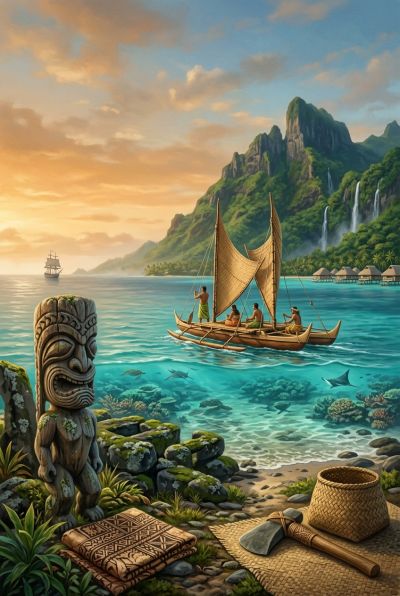
The story of this place does not begin with the tricolor flag of France, nor with the arrival of European sails on the horizon. It begins with one of the most remarkable feats of human migration in history. Long before the first European navigators dared to venture far from the sight of land, Austronesian peoples, the ancestors of today's Polynesians, embarked on epic voyages from Southeast Asia. Using sophisticated knowledge of the stars, winds, and currents, they navigated immense stretches of open ocean in great double-hulled canoes. They arrived first in the Marquesas Islands around 200 BC, and from there, over subsequent centuries, they pushed onwards to settle the Society Islands and the other archipelagos. These were the Ma'ohi, the indigenous people who developed a complex and rich culture deeply intertwined with the sea and the land. They built sacred stone temples called marae, established intricate social hierarchies of chiefs and priests, and passed down their history and mythology through generations of oral tradition.
For centuries, this world remained isolated, a universe of islands connected by canoes and courage. That isolation was irrevocably shattered in the 16th century, though the first encounters were fleeting. The Portuguese explorer Ferdinand Magellan, in the service of Spain, sighted Puka-Puka in the Tuamotus in 1521. But it was the latter half of the 18th century that brought the full, transformative force of European exploration into the region. The British captain Samuel Wallis is credited as the first European to visit Tahiti in 1767, followed swiftly by the Frenchman Louis-Antoine de Bougainville in 1768 and, most famously, Captain James Cook, who would visit three times between 1769 and 1777. These encounters, chronicled in ships' logs and journals, introduced the world to Tahiti and created an enduring, often romanticized, image of a Pacific paradise. They also, however, marked the beginning of a period of profound and often violent change. The introduction of new diseases, firearms, and political ambitions began to unravel the fabric of the old Ma'ohi world.
The 19th century saw these initial contacts solidify into colonial ambition. The arrival of Protestant missionaries from the London Missionary Society in 1797, followed by French Catholics in 1834, brought a new spiritual dimension to the islands, one that would compete with and eventually largely supplant traditional beliefs. This religious rivalry mirrored a larger geopolitical struggle between Britain and France for influence in the Pacific. France ultimately gained the upper hand, establishing a protectorate over Tahiti in 1842 after a period of conflict known as the Franco-Tahitian War. By 1880, the status was changed from protectorate to that of a colony, and the various archipelagos were formally united under a single French administration, initially called the Établissements français d'Océanie (French Establishments of Oceania).
The 20th century pulled the islands into the vortex of global conflicts and technological transformations. Polynesians served in the French military during both World Wars, and the islands served as a strategic outpost. The most profound and lasting impact of the century, however, came after the Second World War. In 1946, the islands' status was changed to an overseas territory, and Polynesians were granted French citizenship. In 1957, the territory was officially renamed French Polynesia. This period also saw the dawn of Tahitian nationalism, a political awakening embodied by the charismatic leader Pouvana'a a Oopa. But this burgeoning political consciousness was soon overshadowed by a new, fearsome chapter in the islands' history: the nuclear era.
Following the independence of Algeria, France sought a new site for its nuclear weapons testing program and selected the atolls of Moruroa and Fangataufa in the Tuamotu Archipelago. Between 1966 and 1996, France conducted 193 nuclear tests, both atmospheric and underground. This era, known locally as le temps de l'expérimentation, brought a massive influx of French military personnel and civil servants, transforming the territory's economy and society. It also unleashed widespread protests and became a galvanizing force for a powerful pro-independence movement, as concerns grew over the health and environmental consequences of the tests. The legacy of the nuclear era continues to shape political discourse and the relationship between Paris and Papeete to this day.
In the decades since the last test, French Polynesia has navigated a complex path toward greater self-governance. A statute of autonomy, first granted in 1977, was extended in 1984 and again in 2004, creating the current status of an "overseas collectivity" with its own president and assembly. The political landscape has been dominated by a dynamic and often contentious debate between those who favor continued autonomy within the French Republic and those who advocate for full independence.
This book traces the long and multifaceted history of these islands, from the first canoes to the complexities of the 21st century. It is a story of remarkable navigation and settlement, of a vibrant and sophisticated culture, of the dislocating impact of European arrival, and of the enduring resilience of the Ma'ohi people. It is a history marked by conflict and accommodation, by the rise and fall of dynasties, the imposition of colonial rule, the trauma of the nuclear age, and the ongoing quest for a political and cultural identity in a globalized world. It is the story of how a vast ocean of islands became, and what it means to be, French Polynesia.
Read “A History of French Polynesia” on MixCache.com →
Please log in or create an account to leave a comment.
No comments yet. Be the first to say something.