

An Excerpt from “A History of Alberta”
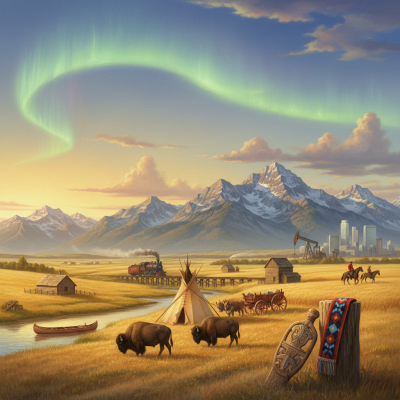
The following is an excerpt from “A History of Alberta” by Richard Devereux, available on MixCache.com.
Introduction
To understand Alberta, you must first understand the land itself. It is a place of dramatic, and often abrupt, transitions. In the span of a few dozen miles, the world can shift from the flat, almost oceanic expanse of the prairies to the jagged, imposing wall of the Rocky Mountains. This is not a subtle landscape; it is a province of grand gestures and sharp contrasts, a geography that has, in turn, shaped a history and a people of similar character. The story of Alberta is a story of what happens when human ambition, in all its forms, confronts a place of such immense scale and resource.
The province’s motto, Fortis et Liber—"Strong and Free"—serves as a fitting, if somewhat romanticized, summary of the identity Albertans have forged. It speaks to a deep-seated belief in self-reliance, a spirit of defiant independence, and a sense of possibility born from the sheer size of the sky and the richness of the ground beneath. Yet, this history is not a simple tale of strength and freedom. It is a complex narrative of contest, adaptation, and consequence, played out across a vast and varied stage. It is a story of successive waves of human occupation, each leaving its indelible mark on the land and on each other.
The physical geography of Alberta is best understood as a series of six distinct ecological regions, each with its own character and its own role to play in the province’s history. In the southeast lies the Grassland Natural Region, the quintessential prairie. This is the land of short-grass and mixed-grass prairie, a semi-arid landscape carved by coulees and river valleys, where the horizon feels limitless. It was here that the great bison herds roamed, sustaining Indigenous societies for millennia and where, later, the first cattle ranches would find a natural home. The soil is rich, a dark treasure that would lure legions of farmers if only the rain would reliably fall.
Moving north and west, the prairie gradually gives way to the Parkland. This is a transitional zone, an aspen-dotted landscape that represents a gentler, more forgiving environment than the open plains. The parkland is a mosaic of grassland, groves of trees, and countless wetlands, a landscape that supported a different rhythm of life for its earliest inhabitants and would later prove to be the agricultural heartland of the province. It is here that the bulk of Alberta’s population would eventually settle, finding a middle ground between the harshness of the open prairie and the dense northern forests.
Beyond the parkland, wrapping around the northern half of the province, lies the Boreal Forest. This vast expanse of coniferous and mixed-wood forest, interspersed with lakes, rivers, and muskeg, is by far Alberta’s largest natural region. For centuries, it was the domain of the trapper and the trader, its intricate network of waterways serving as the highways of the fur trade. In the modern era, it has become the site of immense resource extraction, from forestry to the vast oil sands deposits that lie beneath its surface.
Hugging the eastern slope of the Rocky Mountains is the Foothills region, a rumpled blanket of hills and valleys that serves as a prelude to the mountains themselves. This is a landscape of rolling terrain, mixed forests, and grasslands, a region of stunning beauty and significant natural resources, including the vast coal deposits that first drew industrial attention to the area. It is a zone of intersection, where the ecologies of the mountains and the prairies meet and mingle.
The Rocky Mountains, of course, form the province’s most iconic and dramatic landscape. These are young, sharp-peaked mountains, a formidable barrier that defines Alberta’s western edge. Their glaciers and icefields are the source of the great river systems that flow east across the prairies, providing water for agriculture, industry, and cities. Mount Columbia, the province's highest point, stands as a silent sentinel over this rugged domain. The mountains have been a source of spiritual significance, a barrier to transportation, a driver of tourism, and an enduring symbol of the province’s wild beauty.
Finally, in the far northeastern corner of the province, a small sliver of the Canadian Shield juts into Alberta. This is a land of ancient, hard Precambrian rock, dotted with lakes and thin, acidic soil. It is a landscape more typical of Northern Ontario or Quebec, a reminder of the sheer geological diversity contained within the province’s borders.
These diverse landscapes are crisscrossed by mighty river systems that have served as the arteries of human settlement and commerce for thousands of years. From the Columbia Icefield, the North Saskatchewan and Athabasca Rivers begin their long journeys, the former flowing east towards Hudson Bay and the latter north to the Arctic Ocean. In the south, the Bow and Oldman rivers merge to form the South Saskatchewan, another vital waterway for the southern prairies. The great Peace River carves its way across the northern part of the province, while the Milk River in the far south is unique in that its waters eventually reach the Gulf of Mexico. These rivers and their valleys provided food, transportation routes, and shelter, shaping the patterns of life long before the arrival of Europeans.
The first chapter of Alberta’s human story belongs to its Indigenous peoples, whose ancestors arrived in the region at least 11,000 years ago. This is a history of profound depth and complexity, one that is written not only in archaeological artifacts but also in the rich oral traditions and cultural practices of numerous distinct nations. At Writing-on-Stone Provincial Park, or Áísínai’pi, the largest concentration of First Nation rock carvings and paintings on the great plains stands as a powerful testament to this long and enduring presence.
Before European contact, the peoples of this land had developed sophisticated societies perfectly adapted to its diverse environments. On the plains, nations of the Blackfoot Confederacy—the Siksika, Kainai, and Piikani—developed a culture centred on the bison hunt, a nomadic lifestyle that moved with the great herds. Further north, in the parkland and boreal forest, Woodland Cree, Chipewyan, and Beaver (Dunne-za) peoples lived a life based on hunting moose and caribou, trapping furbearing animals, and fishing. These were complex, self-sufficient societies with intricate social structures, trading networks, and spiritual beliefs deeply connected to the land.
The arrival of Europeans in the mid-18th century marked the beginning of a period of rapid and irreversible change. The engine of this change was the fur trade, a commercial enterprise that would fundamentally reorient the economic and political landscape of the region. Drawn by the demand for beaver pelts in Europe, rival companies, primarily the Hudson's Bay Company and the North West Company, pushed inland, establishing a network of trading posts along the major river systems. Posts like Fort Chipewyan and Fort Edmonton became centres of commerce and cultural exchange, drawing Indigenous peoples into a global economy.
This era was not simply one of European dominance and Indigenous dependency. For a time, a complex middle ground existed. Indigenous peoples were essential partners in the fur trade, their skills as trappers and their knowledge of the land indispensable to the success of the enterprise. They were able to leverage the competition between the rival companies to their advantage, negotiating for favourable terms of trade. This period also saw the emergence of the Métis people, a new and distinct culture born from the unions of European traders and Indigenous women, who would play a crucial role as intermediaries, voyageurs, and buffalo hunters.
However, the fur trade also brought with it profound disruptions. The introduction of European goods, such as firearms and metal tools, altered traditional economies and created new dependencies. Competition for trapping territories intensified, leading to increased conflict between First Nations. Most devastatingly, European diseases like smallpox and measles, to which Indigenous peoples had no immunity, swept through communities, causing catastrophic population losses and social upheaval. The trade also set in motion a process of resource depletion, as the relentless demand for furs began to take its toll on animal populations.
The character of Alberta, and of the Canadian West more broadly, was irrevocably shaped by the decision of the newly formed Dominion of Canada to purchase the vast territory of Rupert's Land from the Hudson's Bay Company in 1869. This transfer set the stage for a new era of colonization, driven by a national policy designed to settle the prairies, build a transcontinental railway, and solidify Canadian sovereignty over the West. The arrival of the North-West Mounted Police in 1874 marked the imposition of federal authority and the beginning of the end for the old frontier way of life.
This period was characterized by the negotiation of treaties between the Crown and the First Nations of the plains and northern forests. These agreements, which will be examined in detail in a later chapter, were understood differently by the parties involved. For the Canadian government, they were a means of extinguishing Aboriginal title to the land, clearing the way for agricultural settlement and railway construction. For many Indigenous leaders, they were seen as sacred agreements to share the land and its resources in exchange for promises of support and the protection of their way of life in the face of the disappearing bison herds and encroaching settlement.
The late 19th and early 20th centuries saw the transformation of Alberta from a fur-trading territory into an agricultural frontier. The Dominion Lands Act of 1872 offered free homesteads to settlers, and the arrival of the Canadian Pacific Railway provided the means to transport people in and crops out. This triggered a massive wave of immigration, drawing people not just from Eastern Canada and Great Britain, but from the United States and continental Europe as well. Ukrainians, Germans, Scandinavians, and many others came, seeking land and opportunity. They broke the sod, built communities, and laid the foundations of a new agricultural economy based on wheat and cattle.
This era of settlement and agricultural expansion culminated in the creation of the province of Alberta on September 1, 1905. Carved out of the North-West Territories along with its twin, Saskatchewan, its birth was part of Prime Minister Wilfrid Laurier’s vision of a new century belonging to Canada. The early years of provincehood were a time of tremendous optimism and growth, a period known as the Laurier Boom. Immigration surged, towns and cities grew at a remarkable pace, and Alberta wheat became a staple on the world market.
The political culture that emerged in this new province was distinct from the start. It was infused with a strain of prairie populism, a suspicion of the established eastern Canadian financial and political powers, and a strong belief in grassroots democracy. This sentiment found its first major political expression in the rise of the United Farmers of Alberta, a movement that swept to power in 1921, promising to govern in the interests of the common farmer against the influence of the banks, railways, and grain companies.
This early history, based on the twin pillars of fur and agriculture, was fundamentally altered by a single event in 1947. The discovery of oil at Leduc No. 1, just south of Edmonton, ushered in the petroleum age and transformed Alberta’s economy and society in ways that are still being felt today. The oil boom turned Alberta into the economic powerhouse of Canada, generating immense wealth and fuelling rapid urbanization. The skylines of Calgary and Edmonton, once modest prairie cities, were reshaped by corporate headquarters, as Alberta became a global centre for the energy industry.
This newfound wealth brought with it a new political dynasty. The Social Credit Party, a quirky populist movement that had governed through the Great Depression and the war years, was replaced in 1971 by the Progressive Conservatives under Peter Lougheed. The Lougheed era was a period of modernization and nation-building within the province, as the government used its oil revenues to invest in infrastructure, education, and healthcare, and to create a sovereign wealth fund, the Alberta Heritage Savings Trust Fund. It was also a time of fierce battles with the federal government over control of natural resources, cementing Alberta’s reputation for federal-provincial conflict.
The story of modern Alberta is a story of boom and bust. The fortunes of the province have become inextricably linked to the volatile price of oil on the world market. The booms have brought prosperity, population growth, and a sense of boundless possibility. The busts have brought recessions, unemployment, and soul-searching about the province's dependence on a single, non-renewable resource. This economic roller coaster has shaped the provincial psyche, fostering a culture of risk-taking and resilience, but also one of anxiety about the future.
Throughout this history, certain themes and tensions recur. There is the persistent rivalry between the province’s two major cities: Edmonton, the government and university town, and Calgary, the corporate and entrepreneurial centre. There is the ongoing struggle to diversify the economy beyond its traditional reliance on agriculture and energy. There is the complex and often fraught relationship between the province and the federal government in Ottawa, a relationship characterized by a sense of western alienation and a demand for greater autonomy.
There is also the enduring question of identity. To the rest of Canada, and indeed to many within its own borders, Alberta is often seen through a series of stereotypes: a province of cowboys, oil barons, and staunch conservatives. While rooted in aspects of the province’s history, this image fails to capture the full complexity of modern Alberta. It is a province of vibrant multicultural cities, a growing technology sector, and a political landscape that, while often conservative, has also produced periods of radical populist and even social democratic government. Recent studies suggest that most Albertans see themselves as political moderates, even if they perceive their province as a whole to be more conservative than it actually is.
This book will trace the long and winding path of Alberta's history, from its deep Indigenous roots to its present-day challenges and opportunities. It will explore the forces that have shaped its unique landscape, economy, and culture. It is a story of the interplay between geography and human endeavour, of the collision of cultures, and of the enduring search for prosperity and identity in Canada’s wild west. It is the story of a place that is, in many ways, a microcosm of the larger Canadian experiment, a province built by people from all corners of the globe on land with an ancient history. It is, in short, a history of a land and a people who are, and have always been, strong and free.
Read “A History of Alberta” on MixCache.com →
Please log in or create an account to leave a comment.
No comments yet. Be the first to say something.