
Browse by Category
Fiction
- Action & Adventure
- African American
- Anthologies
- Children's Fiction
- Classics
- Comics & Graphic Novels
- Coming of Age
- Contemporary
- Cultural & Regional
- Drama
- Erotica
- Fantasy
- General
- Historical Fiction
- Horror
- Humor & Satire
- Literary Fiction
- Mystery, Thriller & Suspense
- Poetry
- Religious & Inspirational
- Romance
- Science Fiction
- Short Stories
- War & Military
- Westerns
- Women's Fiction
- Young Adult
Non-Fiction
- Antiques & Collectibles
- Arts & Photography
- Biographies & Memoirs
- Business & Money
- Children's Non-Fiction
-
Computers & Technology
- Artificial Intelligence
- Computer Science
- Cybersecurity & Cryptography
- Data Science & Analytics
- Databases & Big Data
- Game Development & Design
- General
- Hardware & DIY
- Mobile App Development
- Networking & Cloud Computing
- Operating Systems
- Programming
- Robotics
- Software
- Software Engineering
- User Experience (UX) & Design
- Web Development & Design
- Cooking, Food & Wine
- Crafts, Hobbies & Home
- Education & Teaching
- Engineering
- General
- Health, Fitness & Dieting
-
History
- African History
- African History - North Africa
- African History - Sub-Saharan Africa
- American History
- American History - 20th Century
- American History - Civil War
- American History - Colonial Period
- Ancient History
- Asian History
- Asian History - China
- Asian History - India
- Asian History - Japan
- Asian History - Southeast Asia
- European History
- European History - Ancient Greece
- European History - Ancient Rome
- European History - Medieval
- European History - Modern
- European History - Renaissance
- General
- Middle Eastern History
- Military History
- Military History - Aviation
- Military History - Naval
- Social & Cultural History
- World History
- Humor & Entertainment
- Industrial Technology
- Language Learning
- Law
- LGBTQ+ Non-Fiction
- Literary Criticism
- Medical Books
- Parenting & Relationships
- Philosophy
- Politics & Social Sciences
- Reference
- Religion & Spirituality
-
Science & Math
- Agricultural Sciences
- Astronomy & Space Science
- Behavioral Sciences
- Biological Sciences
- Botany & Plant Science
- Chemistry
- Earth Sciences
- Engineering - Chemical
- Engineering - Civil
- Engineering - Electrical
- Engineering - Mechanical
- Environment
- General
- Geology
- Mathematics
- Nature & Ecology
- Oceanography
- Paleontology
- Physics
- Statistics
- Self-Help
- Sports & Outdoors
- Study Aids
- Sustainability & Green Living
- Textbooks
- Transportation
- Travel
- True Crime
- Urban Planning & Development
- Veterinary Medicine
- Writing & Publishing
Jump to Section

Want unlimited access to all books published by MixCache.com (plus their audiobooks)? Try MixCache.com Total Access. Look for the MTA badge on book covers to identify included titles.
Access to infinite ebooks: Don't see the book you want? Suggest it and we'll create it (free!) for you from scratch with our powerful AI book writer. Then read it with MTA - besides profiting from any sales it makes!
Faiths of Africa: Islam, Christianity, and Indigenous Religions in Historical Perspective
MTA
Conversions, Syncretism, and Religious Institutions over Millennia
About this book:
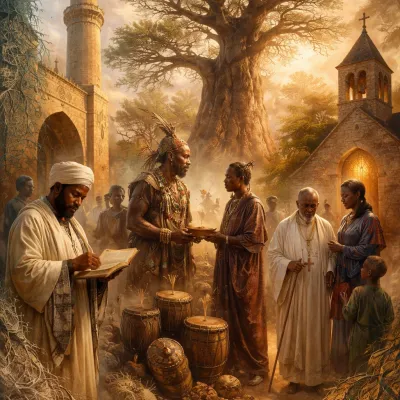
"Faiths of Africa: Islam, Christianity, and Indigenous Religions in Historical Perspective" offers a comprehensive survey of religious change across the African continent over millennia, emphasizing conversion as a nuanced, layered process rather than a definitive break. The book highlights the creative patterns of syncretism and the enduring resilience of indigenous religious systems alongside the diffusion and adaptation of Islam and Christianity. It meticulously draws upon a wide array of sources, including archaeology, historical texts, and oral traditions, to reconstruct the complex interplay of religious ideas with political, economic, and social institutions. The narrative consistently foregrounds African intellectuals and communities as active agents in shaping their spiritual landscapes.
The book traces the historical foundations of African religions from ancient Egypt, Nubia, and Aksum, through the emergence of North African Christianity and the multi-pronged arrival of Islam via conquest, trade, and scholarship. It delves into the flourishing of Islamic learning in Sahelian empires like Ghana, Mali, and Songhay, and the profound social influence of Sufi orders such as the Qadiriyya, Tijaniyya, and Muridiyya. Concurrently, it explores the distinctive Swahili Islamic civilization forged along the Indian Ocean coast and the enduring Christian statecraft in Ethiopia, while also examining the ritual sovereignties of central and southern African polities like Kongo and Great Zimbabwe, emphasizing the crucial role of rainmaking.
Later chapters address the profound impact of the Atlantic slave trade on religious creativity in the Black Atlantic, the complex role of Christian missions and empire in introducing schools, print, and medicine, and the transformative Islamic reform and jihad movements of the 18th and 19th centuries, notably the Sokoto and Futa states. The text then analyzes how colonial governance shaped religious law through customary courts and Sharia, and how religious nationalisms fueled anticolonial movements. The book concludes by exploring the rise of African-founded and prophetic churches (Zionists, Aladura, Kimbanguists), the widespread phenomenon of Pentecostal and charismatic Christianity, and the diverse manifestations of postcolonial Islam, including Salafism and Islamism.
Throughout, the book maintains a thematic focus on recurring issues like gender and generational dynamics in religious authority, the evolution of education and knowledge economies from Qur’anic schools to universities, the intricate relationship between health, healing, and spiritual power, and the complex interplay of religion, law, and the state in the post-independence era. Finally, it examines the contemporary impact of migration, urbanism, and digital technologies on the global circulation and ongoing transformation of African religions. The overarching message is that Africa has been a generative center of religious thought and experience, where faiths are continually refashioned and deeply intertwined with the continent's social and political fabric.
What You'll Find Inside:
- The book presents conversion as a layered, negotiated process rather than a clean break, showing how Africans adopted new religious practices while retaining older ritual grammars and reinterpreting sacred geographies in response to political and economic changes.
- It demonstrates how syncretism reflects religious creativity rather than dilution, with communities blending Islamic, Christian, and indigenous elements to create localized expressions of faith that address local problems and maintain cultural continuity.
- The work traces how religious institutions (mosques, churches, shrines, Sufi lodges) have shaped education, law, and identity formation across millennia, serving as centers of learning, welfare, and community organization.
- It highlights the central role of women and youth in religious renewal, showing how they have been patrons, teachers, healers, visionaries, and media entrepreneurs driving religious innovation and adaptation.
- The book examines how urbanization, migration, and digital media have reconfigured religious communities, creating transnational devotional networks that link local practices to global circuits while maintaining local relevance.
Who's It For:
This book is ideal for undergraduate and graduate students, researchers, and scholars in African studies, religious studies, anthropology, and history who seek a comprehensive, source-driven analysis of religious change across the continent. It will particularly benefit those interested in cultural and intellectual history, comparative religion, and the interplay between faith, identity, and social institutions. Readers looking for a nuanced understanding of conversion, syncretism, and the resilience of indigenous traditions in dialogue with world religions will find this work essential for grasping Africa's role as a generative center of religious thought and experience.
Author:
Published By:
Date Published:
May 6, 2026
Type:
Nonfiction
Language:
English
Word Count:
64,738 words
Reading Time:
4 hours 32 minutes
Sample:
MixCache.com Total Access
Get unlimited access to this book + all books published by MixCache.com for $11.99/month
Subscribe to MTAOr purchase this book individually below
Order:
Buy the Faiths of Africa: Islam, Christianity, and Indigenous Religions in Historical Perspective ebook on MixCache.com:
Buy Now
Full ebook will be available immediately
- read online or download as a PDF file.
$5 account credit for all new MixCache.com accounts, usable toward any ebook purchase!*


Ratings & Reviews
Ask Questions About This Book
Have a question about the content? Ask our AI assistant!
Start by asking a question about "Faiths of Africa: Islam, Christianity, and Indigenous Religions in Historical Perspective"
Example: "Does this book mention William Shakespeare?"
Thinking...