
Browse by Category
Fiction
- Action & Adventure
- African American
- Anthologies
- Children's Fiction
- Classics
- Comics & Graphic Novels
- Coming of Age
- Contemporary
- Cultural & Regional
- Drama
- Erotica
- Fantasy
- General
- Historical Fiction
- Horror
- Humor & Satire
- Literary Fiction
- Mystery, Thriller & Suspense
- Poetry
- Religious & Inspirational
- Romance
- Science Fiction
- Short Stories
- War & Military
- Westerns
- Women's Fiction
- Young Adult
Non-Fiction
- Antiques & Collectibles
- Arts & Photography
- Biographies & Memoirs
- Business & Money
- Children's Non-Fiction
-
Computers & Technology
- Artificial Intelligence
- Computer Science
- Cybersecurity & Cryptography
- Data Science & Analytics
- Databases & Big Data
- Game Development & Design
- General
- Hardware & DIY
- Mobile App Development
- Networking & Cloud Computing
- Operating Systems
- Programming
- Robotics
- Software
- Software Engineering
- User Experience (UX) & Design
- Web Development & Design
- Cooking, Food & Wine
- Crafts, Hobbies & Home
- Education & Teaching
- Engineering
- General
- Health, Fitness & Dieting
-
History
- African History
- African History - North Africa
- African History - Sub-Saharan Africa
- American History
- American History - 20th Century
- American History - Civil War
- American History - Colonial Period
- Ancient History
- Asian History
- Asian History - China
- Asian History - India
- Asian History - Japan
- Asian History - Southeast Asia
- European History
- European History - Ancient Greece
- European History - Ancient Rome
- European History - Medieval
- European History - Modern
- European History - Renaissance
- General
- Middle Eastern History
- Military History
- Military History - Aviation
- Military History - Naval
- Social & Cultural History
- World History
- Humor & Entertainment
- Industrial Technology
- Language Learning
- Law
- LGBTQ+ Non-Fiction
- Literary Criticism
- Medical Books
- Parenting & Relationships
- Philosophy
- Politics & Social Sciences
- Reference
- Religion & Spirituality
-
Science & Math
- Agricultural Sciences
- Astronomy & Space Science
- Behavioral Sciences
- Biological Sciences
- Botany & Plant Science
- Chemistry
- Earth Sciences
- Engineering - Chemical
- Engineering - Civil
- Engineering - Electrical
- Engineering - Mechanical
- Environment
- General
- Geology
- Mathematics
- Nature & Ecology
- Oceanography
- Paleontology
- Physics
- Statistics
- Self-Help
- Sports & Outdoors
- Study Aids
- Sustainability & Green Living
- Textbooks
- Transportation
- Travel
- True Crime
- Urban Planning & Development
- Veterinary Medicine
- Writing & Publishing
Jump to Section
MixCache.com Total Access
Unlimited reading and audiobooks for every book published by MixCache.com.
Included titles carry the MTA badge.
Learn more →
The Global Ocean Observing System: Networks, Data, and Decision-Making
MTA
How ARGO, gliders, moorings, and satellites create integrated ocean intelligence
About this book:
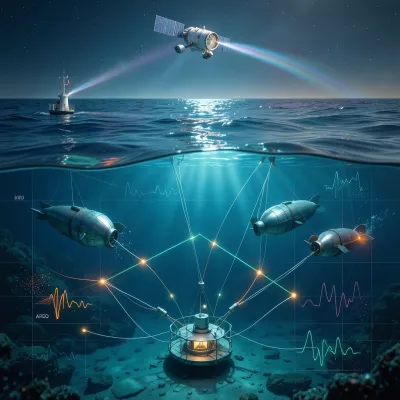
The Global Ocean Observing System (GOOS) represents a sophisticated, international effort to transform the ocean from an opaque frontier into a transparent, predictable domain. By integrating a diverse fleet of technologies—including Argo profiling floats, autonomous gliders, moored observatories, surface drifters, and a constellation of satellites—the system creates "ocean intelligence." This end-to-end architecture relies on standardized data protocols (such as netCDF-CF and FAIR principles) and rigorous quality control to ensure that raw environmental signals are converted into reliable, interoperable datasets. These observations are essential for initializing numerical models, enabling real-time forecasts for weather, waves, and climate variability.
The book details the specific roles of various platforms: Argo floats provide a steady heartbeat of temperature and salinity in the interior ocean; gliders offer persistent eyes on dynamic mesoscale fronts; and moorings act as the system’s memory, providing high-frequency time series at fixed locations. Meanwhile, satellite altimetry and sensors for sea surface temperature, ocean color, and winds offer the synoptic surface context necessary for basin-scale monitoring. These tools are increasingly being extended into the deep ocean and polar regions to close critical observational gaps and include biogeochemical variables, such as oxygen and pH, which are vital for understanding the ocean's role in the global carbon cycle and ecosystem health.
Beyond pure science, this integrated system provides indispensable decision support for marine operations, including navigation, offshore energy, and sustainable fisheries. By quantifying the value of information and reducing uncertainty, GOOS supports disaster preparedness and climate adaptation strategies. Emerging technologies like digital twins and machine learning are further revolutionizing the field, allowing for more interactive and predictive simulations of the marine environment. However, the system's longevity remains dependent on complex international governance, sustained funding models, and a commitment to global capacity development to ensure equitable participation across all nations.
As the planet faces accelerating climate change, the future of ocean observing lies in achieving a truly sustainable and integrated global network. This requires moving from project-based funding to infrastructure-based investment and maintaining a "human infrastructure" of expertise and cooperation. By bridging the gap between hardware, data science, and societal needs, the Global Ocean Observing System serves as a vital planetary diagnostic tool, ensuring that humanity can navigate a changing environment with foresight and informed stewardship.
What You'll Find Inside:
- How Argo floats, autonomous gliders, moorings, and satellite constellations work together to provide integrated, real‑time ocean intelligence.
- The role of community data standards (netCDF‑CF, ISO, FAIR principles) in enabling interoperability, discovery, and long‑term stewardship of ocean observations.
- End‑to‑end data pipelines: from sensor acquisition and transmission through quality control, delayed‑mode processing, and delivery via services like ERDDAP and THREDDS.
- Applications of ocean observing in weather and climate forecasting, marine operations (navigation, energy, fisheries, safety), and decision support through value‑of‑information analysis.
- Emerging frontiers such as Deep and Biogeochemical Argo, digital twins, machine learning, and the challenges of funding, equity, and sustaining a global observing system.
Who's It For:
This book is written for graduate students entering ocean observing science, practitioners who design, build, and maintain observing networks, analysts and forecasters who transform observations into operational products, and decision‑makers who rely on trustworthy ocean intelligence for climate adaptation, marine safety, and resource management. Readers will gain a systems‑level understanding of how observations are collected, processed, and turned into actionable information.
Table of Contents:
- Introduction
- Chapter 1 The Promise and Practice of Global Ocean Observing
- Chapter 2 GOOS Origins, Mandates, and Governance
- Chapter 3 System Architecture: From Sensors to Services
- Chapter 4 Argo: Profiling the Interior Ocean
- Chapter 5 Deep and Biogeochemical Argo: Beyond Temperature and Salinity
- Chapter 6 Autonomous Gliders: Persistent Eyes on the Mesoscale
- Chapter 7 Moorings and Fixed Platforms: Time Series at Key Sites
- Chapter 8 Surface Drifters and HF Radars: Mapping the Moving Skin
- Chapter 9 Satellite Altimetry: Sea Level and Geostrophic Currents
- Chapter 10 Satellite SST, Ocean Color, and Surface Winds
- Chapter 11 SAR and SWOT: High-Resolution Views of the Sea Surface
- Chapter 12 Polar and Marginal Seas: Observing the Edges of the System
- Chapter 13 Under-Sampled Regions: Closing Gaps in the Deep and the South
- Chapter 14 Data Standards: netCDF-CF, ISO, and the FAIR Principles
- Chapter 15 Real-Time Data Flows: GTS/WIS, Streaming APIs, and DOIs
- Chapter 16 Quality Control and Delayed-Mode Processing
- Chapter 17 Data Hubs and Services: ERDDAP, THREDDS, and OPeNDAP
- Chapter 18 Data Assimilation and Reanalyses: From Observations to State Estimates
- Chapter 19 Coupled Forecast Systems: Weather, Waves, and Ocean
- Chapter 20 Climate Applications: Indicators, Attribution, and Projections
- Chapter 21 Marine Operations: Navigation, Energy, Fisheries, and Safety
- Chapter 22 Decision Support and the Value of Information
- Chapter 23 Digital Twins and Machine Learning for the Ocean
- Chapter 24 Funding Models, Partnerships, and Capacity Development
- Chapter 25 Future Horizons: An Integrated, Equitable, and Sustainable System
Author:
Published By:
Date Published:
May 4, 2026
Type:
Nonfiction
Language:
English
Word Count:
57,411 words
Reading Time:
4 hours 1 minutes
Sample:
MixCache.com Total Access
Get unlimited access to this book + all books published by MixCache.com for $11.99/month
Subscribe to MTAOr purchase this book individually below
Order:
Buy the The Global Ocean Observing System: Networks, Data, and Decision-Making ebook on MixCache.com:
Buy Now
Full ebook will be available immediately
- read online or download as a PDF file.
$5 account credit for all new MixCache.com accounts, usable toward any ebook purchase!*


Ratings & Reviews
Ask Questions About This Book
Have a question about the content? Ask our AI assistant!
Start by asking a question about "The Global Ocean Observing System: Networks, Data, and Decision-Making"
Example: "Does this book mention William Shakespeare?"
Thinking...